

Chinmaya Mission Timeline

An afternoon midsummer dream, born on the banks of the roaring Ganga at Gangotri, grew into an irresistible calling. The rushing waters of the mighty river sparked in the young Swami Chinmayananda, a divine vision to bring the ancient wisdom of Vedanta from the Himalayas down to the common people. Gaining permission from his Guru, Swami Tapovan Maharaj, He set out on an All-India Tour from May to October of 1951. When He returned to Uttarkashi, Swami Chinmayananda carefully envisioned the Gangotri Plan, initiating a spiritual revolution through self-unfoldment and selfless service.
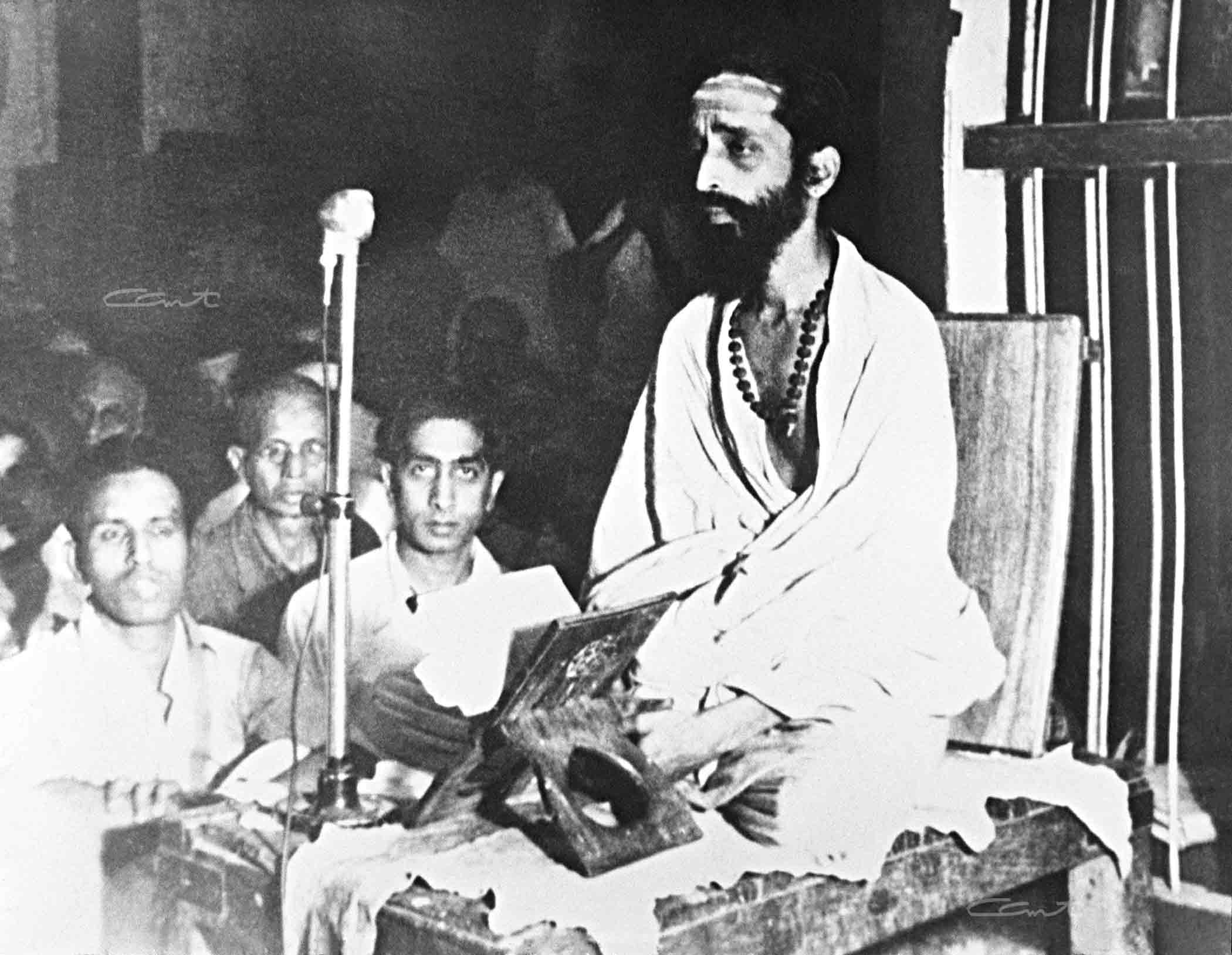
With four annas (currency unit formerly used in British India) in his pocket, Swami Chinmayananda alighted at the railway station of Pune (then known as Poona) on 23 December 1951 and began his first discourse that very evening. In those days, yajna meant the long traditional havans, the elaborate fire rituals. Taking cue from the Bhagavad Gita, he brought alive the jnana yajna (a series of Spiritual Discourses), where the fire of spiritual knowledge is kindled and the primal ignorance is burnt forever. The 100-day Upanishad Jnana Yajna that followed was a saga par excellence.
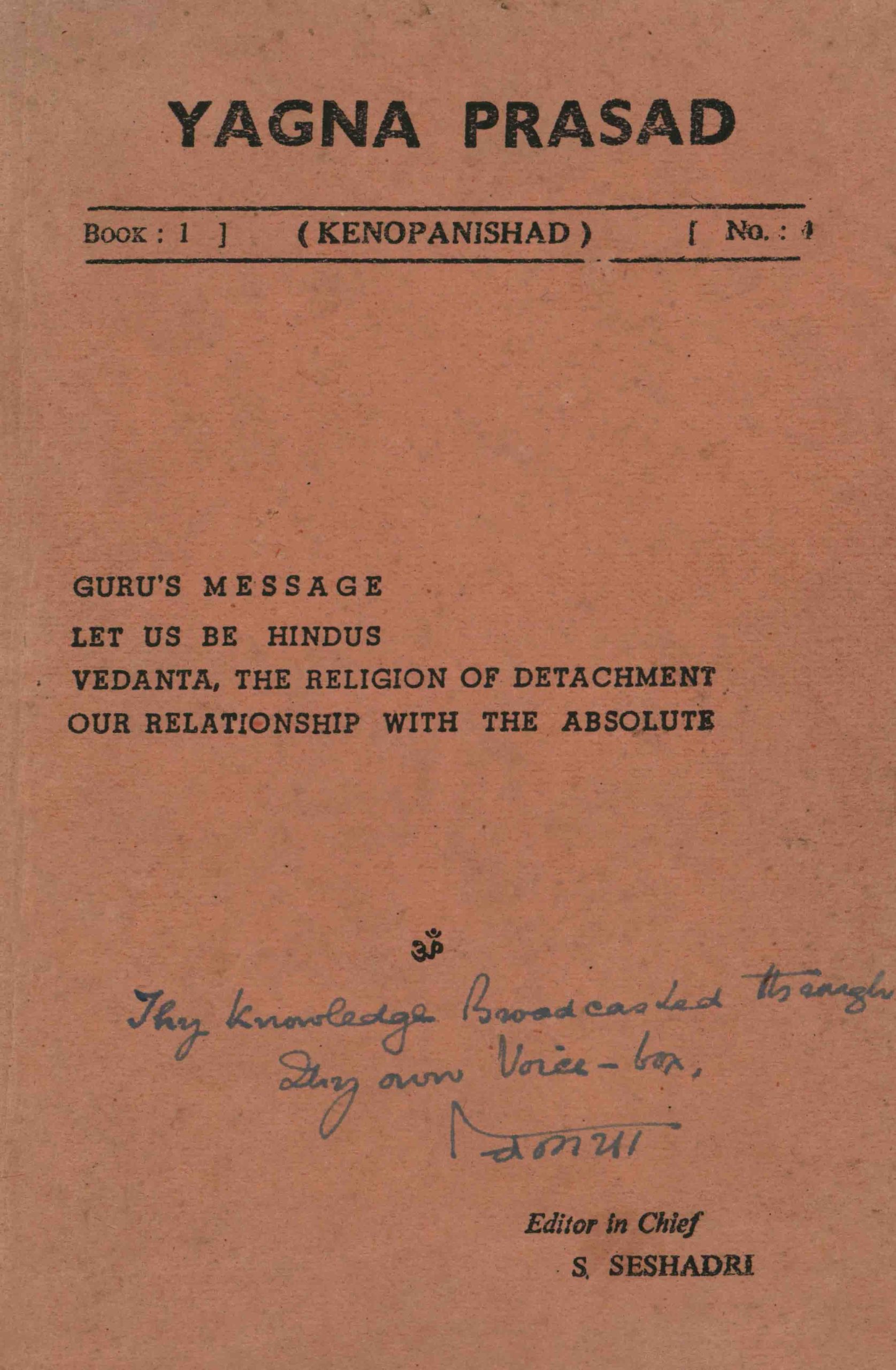
The fire of spiritual thirst had been kindled by that incomparable 100-day Upanishad Jnana Yajna, and Gurudev was astute about keeping the flames growing. He ensured that every discourse starting from His introductory talks on Hinduism in several public venues before the first yajna were carefully recorded on paper. Gurudev personally reviewed the shorthand notes, and the edited discourses were printed within 24 hours as booklets titled “Yagna Prasad.” With great humility, Gurudev sent the first copy of the Yagna Prasad to his Guru, Swami Tapovan Maharaj, in Uttarkashi, with the message, “Thy Knowledge Broadcasted through Thy own Voice-box.”
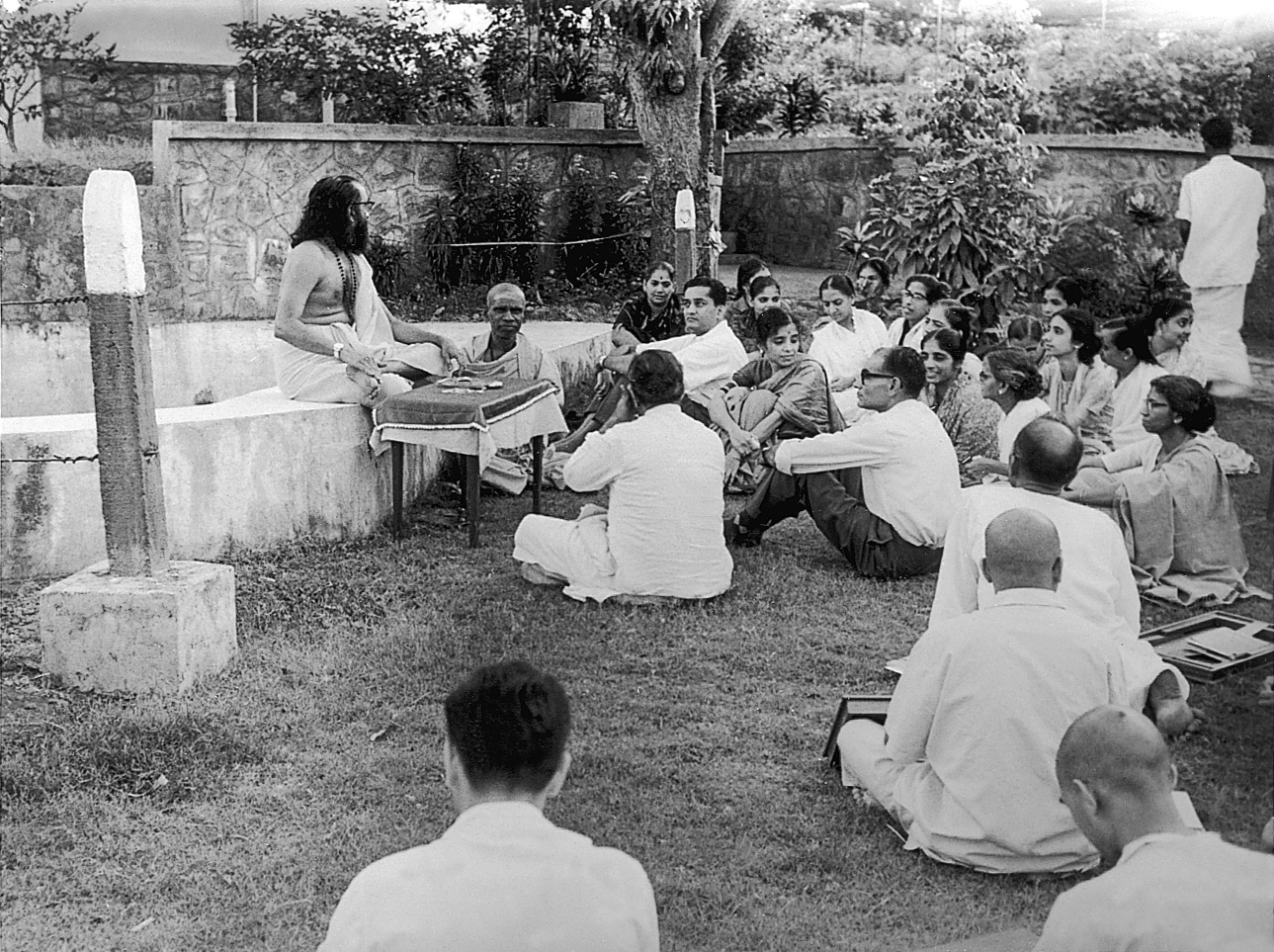
Gurudev’s thunderous pravachans (discourses) left seekers thirsting for more. Many sincere seekers who were captivated by His compelling wisdom wanted to bask in His teachings. This desire to reflect, relearn, and reinforce through joint discussions spawned the Chinmaya Study Groups that sprung up in every city beginning with the second Jnana Yajna in Chennai. Though Gurudev had encouraged seekers to strengthen their understanding through small group study sessions during the very first Jnana Yajna, the first structured Study Group truly took shape after the second Jnana Yajna. This initiative eventually gave rise to the formation of Chinmaya Mission as the guiding and coordinating organisation.
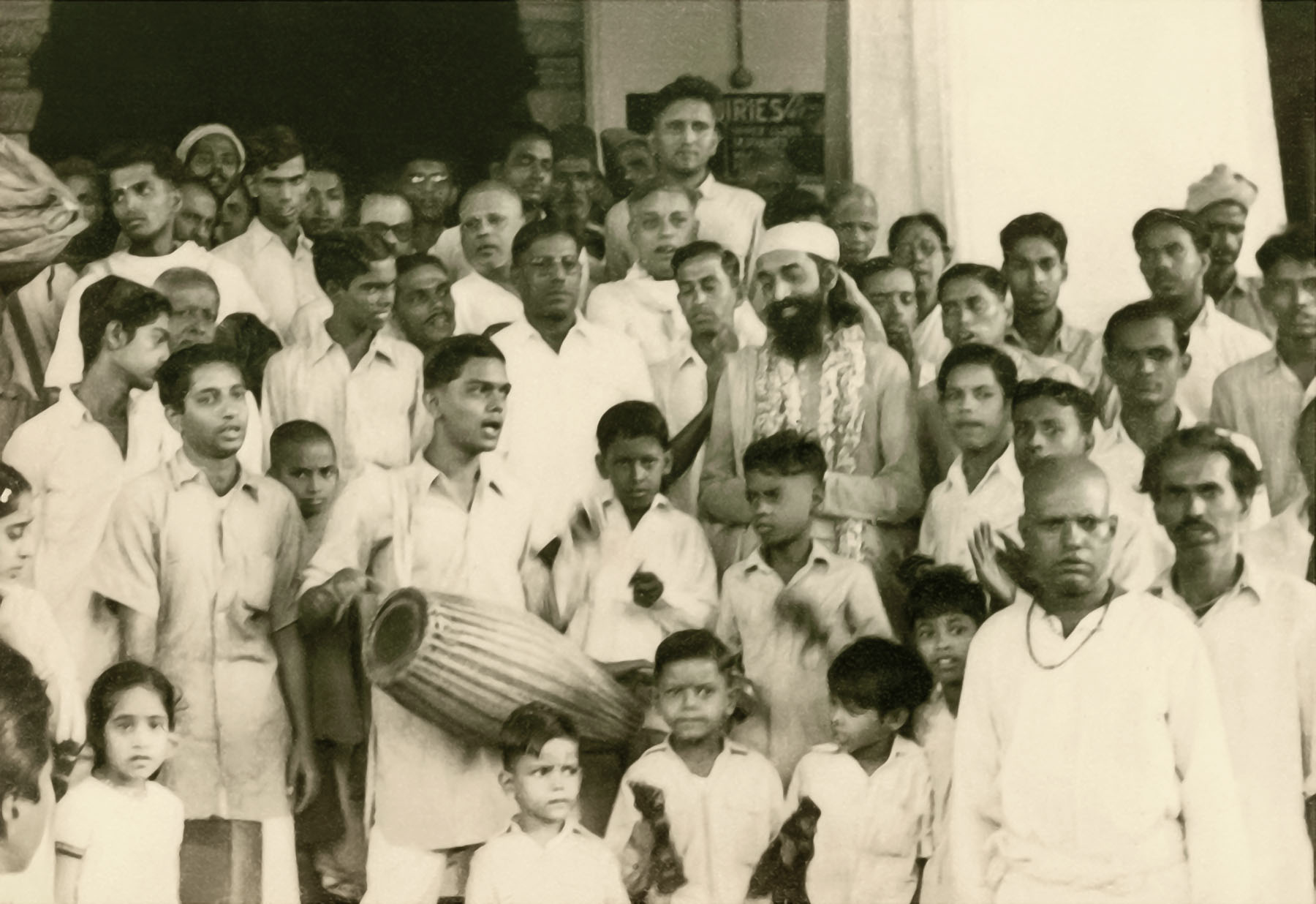
“Don’t start any organisation in my name. I have not come here to be institutionalised. I have come here to give the message of our ancient sages, which has benefited me. If it has benefited you also, pass it on.” This was the reply that a group of earnest devotees received when they wrote to Gurudev in Uttarkashi after the second yajna in Chennai that ended in June 1953. What they wanted was an umbrella organisation to unite the growing forums of deeper study and reflection. So, they persisted: Since the word ‘Chinmaya’ stood for ‘true knowledge,’ and they were seekers of that Truth, it was apt to call the organisation, “Chinmaya Mission.” When Gurudev accepted that request with His compassion, Chinmaya Mission was born and registered on 8 August 1953.
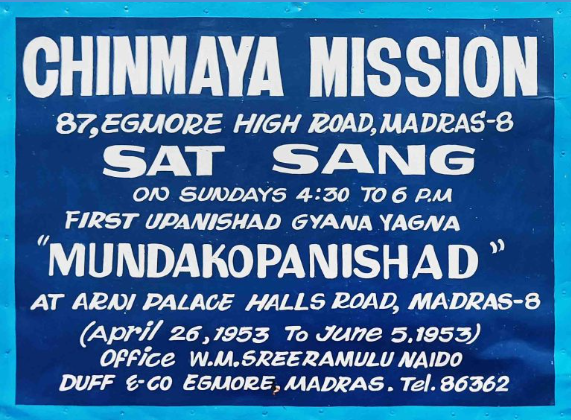
The pace picked up significantly after the second Yajna in Chennai gave birth to Chinmaya Mission. While the organisation formulated its structure and code of conduct, Gurudev took the message of the major Upanishads to the prominent cities of India to awaken and elevate the educated. From Mundakopanishad in Madras (now Chennai), He elevated the intensity in Mandukya Upanishad in Delhi and drenched the rest of the cities with His Vedantic eloquence during His first eleven Upanishad Jnana Yajnas.
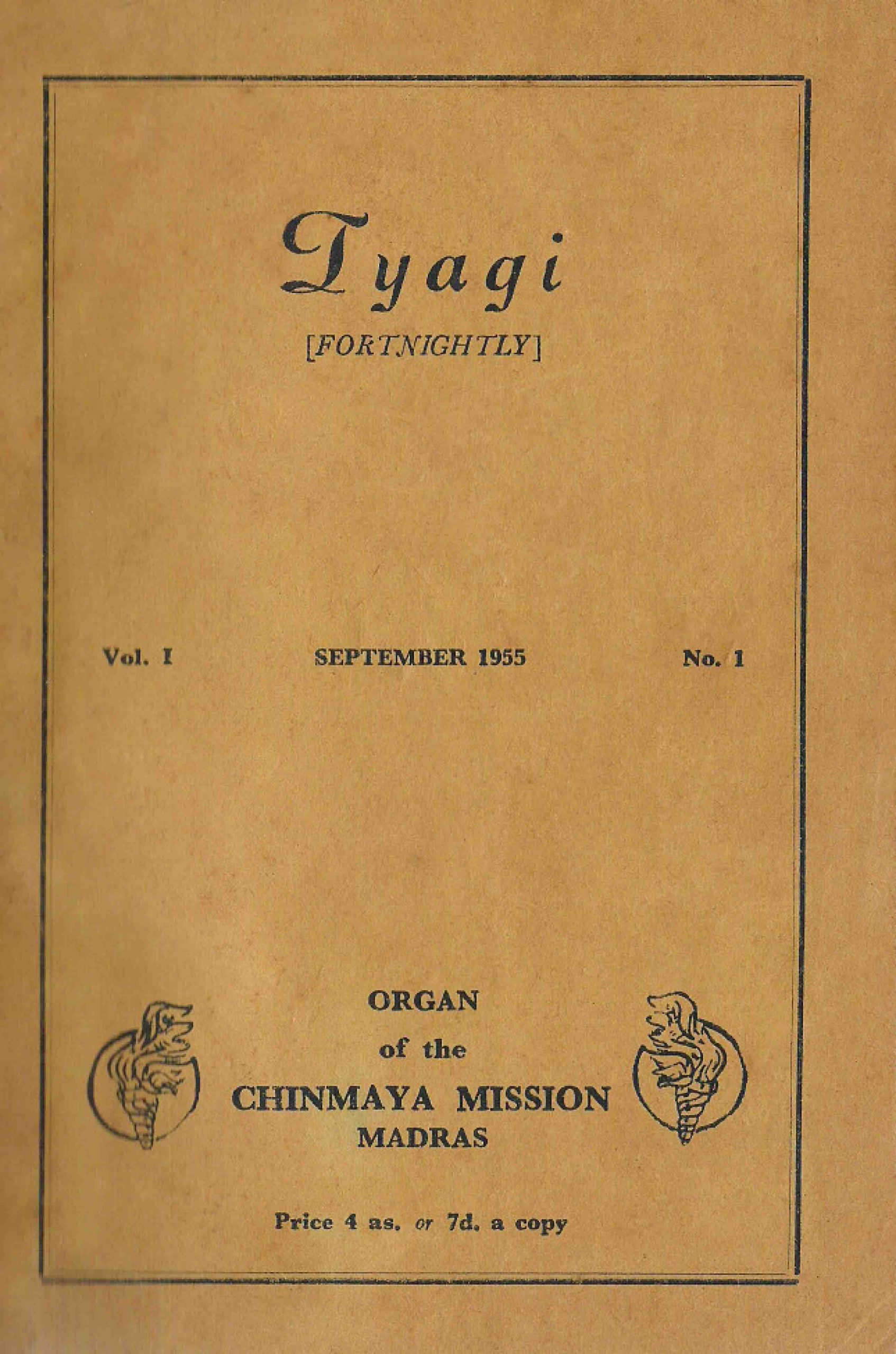
By the September of 1955, there were already more than 35,000 ardent devotees who had reached out to Gurudev requesting for the Yagna Prasad booklets to be mailed to their addresses. Recognising the great demand for the booklets and the fact that it was becoming inefficient timewise and financially to do the bulk mailing, an enthusiastic group seeked Gurudev’s approval for the launch of a fortnightly magazine. “Tyagi” was born on 1 September 1955, with Gurudev’s exhortation, “May Tyagi hold the torch high…” A treasured blessing followed from Swami Tapovan Maharaj as He received the first issue.
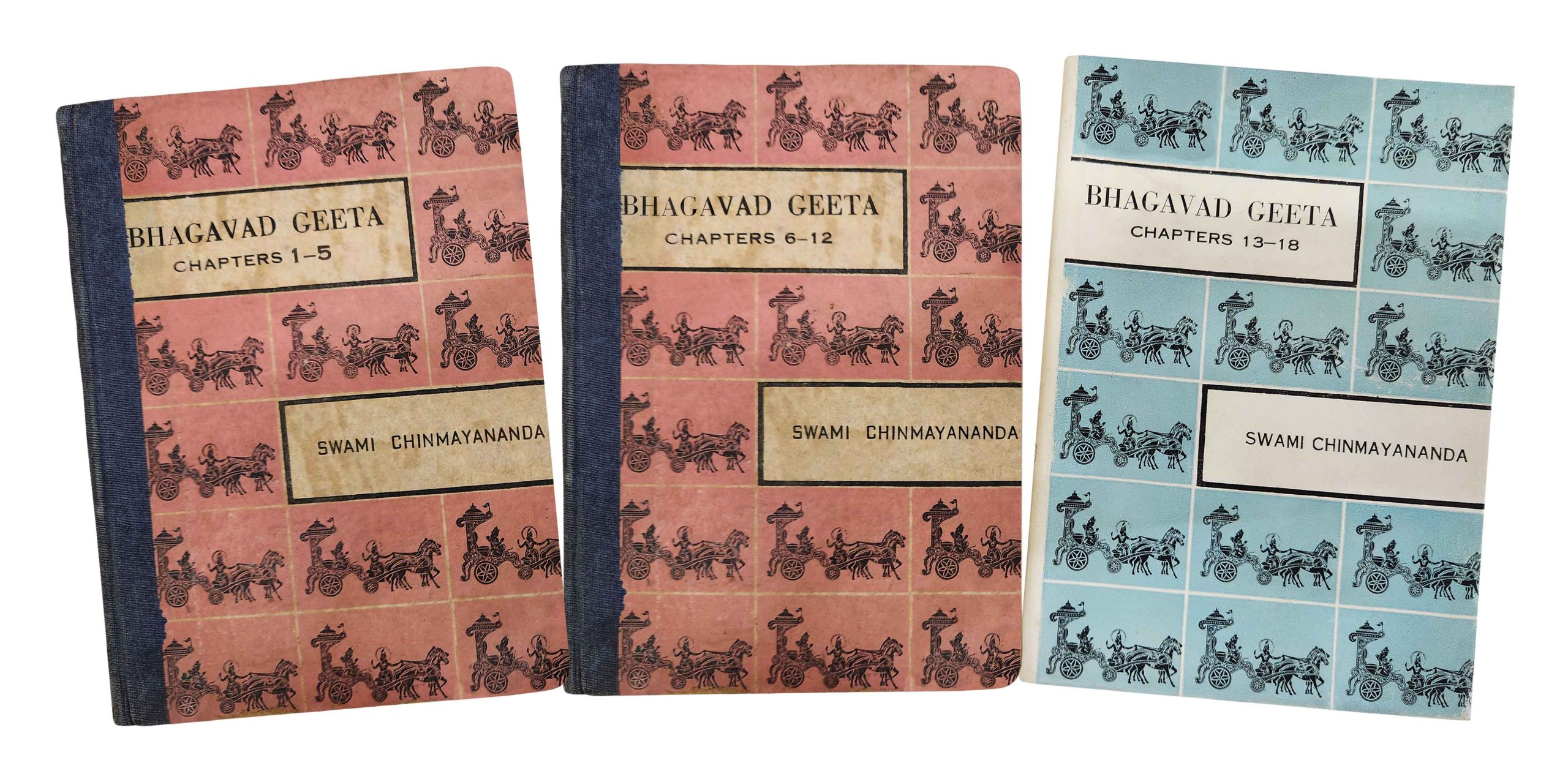
“The Gita is therefore to be studied and delivered to as many devotees as possible. This Pravachana – missionary zeal in propagation – has been emphasized in our scriptures also. The Lord’s Divine Song was not a prescription for one Arjuna of the Mahabharata days. It is for all times to all of us – Arjuna is a sample young man of the world,” stated Gurudev during His first Gita Jnana Yajna (18 Sep – 26 Oct 1955) at the Modern School, Barakhambha Road, New Delhi, after He explained the meaning of the Gita Dhyanam and highlighted the lasting relevance of Srimad Bhagavad Gita.
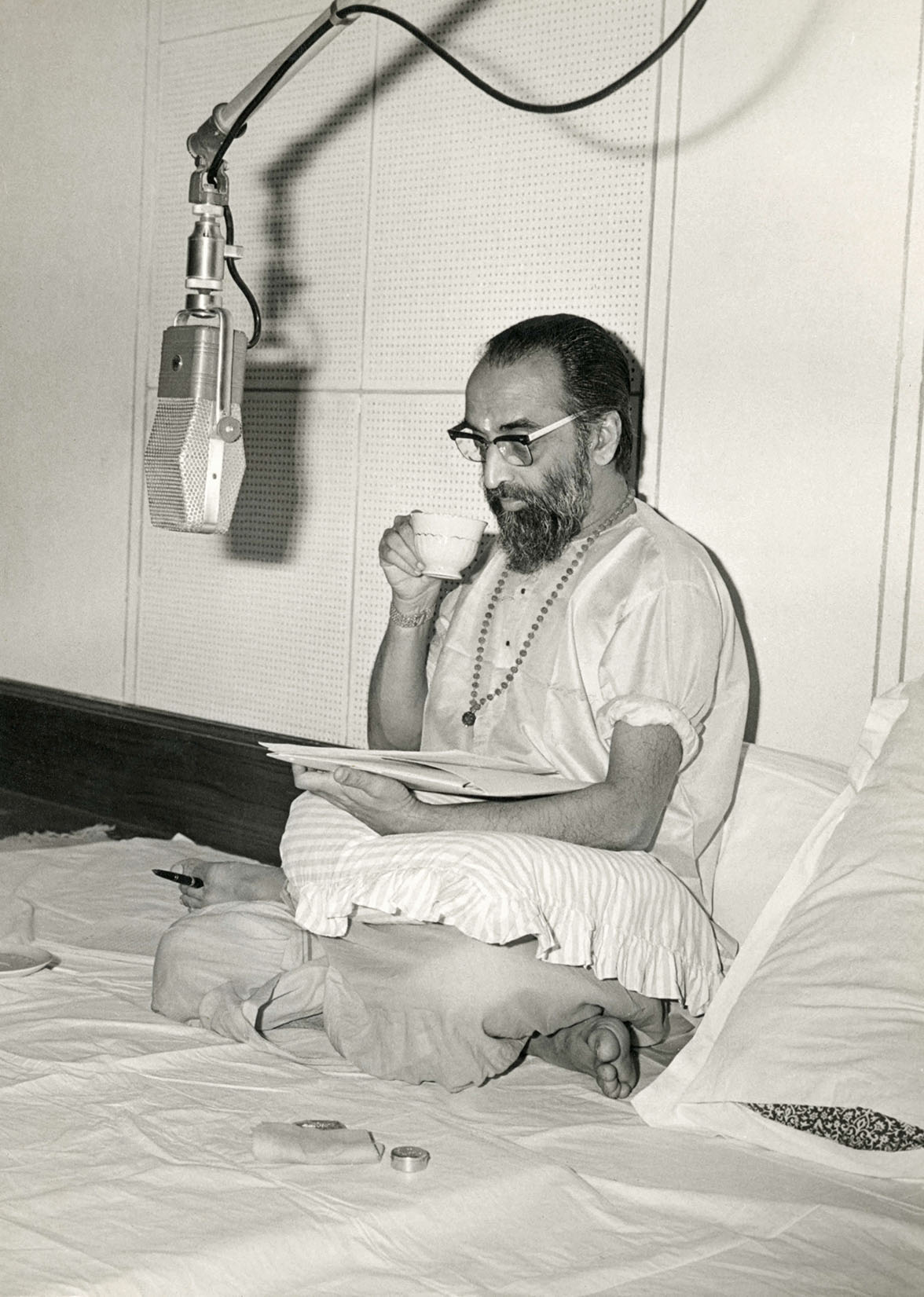
During the 13th Jnana Yajna in New Delhi, Gurudev was invited by All India Radio, the national public broadcaster, for a three-part broadcast on key topics in spirituality. With His commanding voice, He reminded Indians again about their spiritual status: “Ours is an Age of Science. The new India, thrilled with her freedom, is looking forward to a healthy future wherein the maximum number can come to enjoy the maximum amount of peace and happiness in life. From time immemorial, ours has been the land of spiritualism, and the whole world has been looking up to us to teach them the right way of living…”
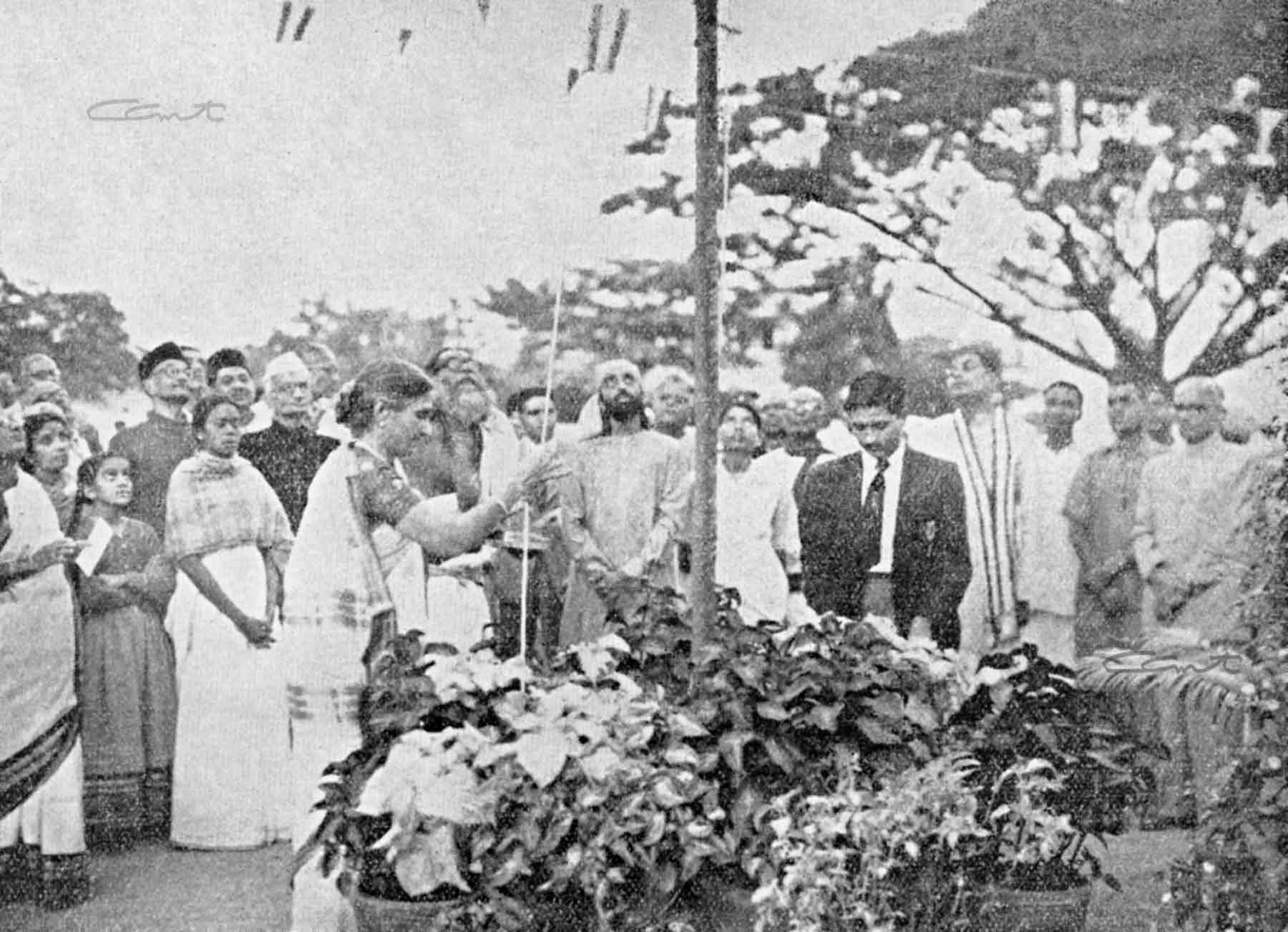
From December 1951 in Pune to December 1956 in Hyderabad, Gurudev’s tireless efforts through Jnana Yajnas ignited a wave of renewed interest in the Vedic scriptures. To commemorate the sterling milestone at the 25th Jnana Yajna, the first volume of a publication called “Hail Renaissance” was brought out. Crowning the publication was a letter from Gurudev dated 20 December 1956 heralding the budding Hindu Renaissance. It also included His article about the genesis of the Chinmaya movement along with testimonials from devotees.

“Death is born with us when we are born,” consoled a deeply ailing Swami Tapovan Maharaj when Gurudev was heartbroken during the last meeting with His peerless Guru in the first week of December 1956. Then, at the serene and auspicious time of 4:30 AM on the full moon day of 16 January 1957, Swami Tapovan Maharaj attained Mahasamadhi. In His most reverential tribute, Gurudev expressed, “A God without temple, A Veda without language, was this master mind and he lived for 68 years; a monumental expression of an ideal Vedantic Teacher.”
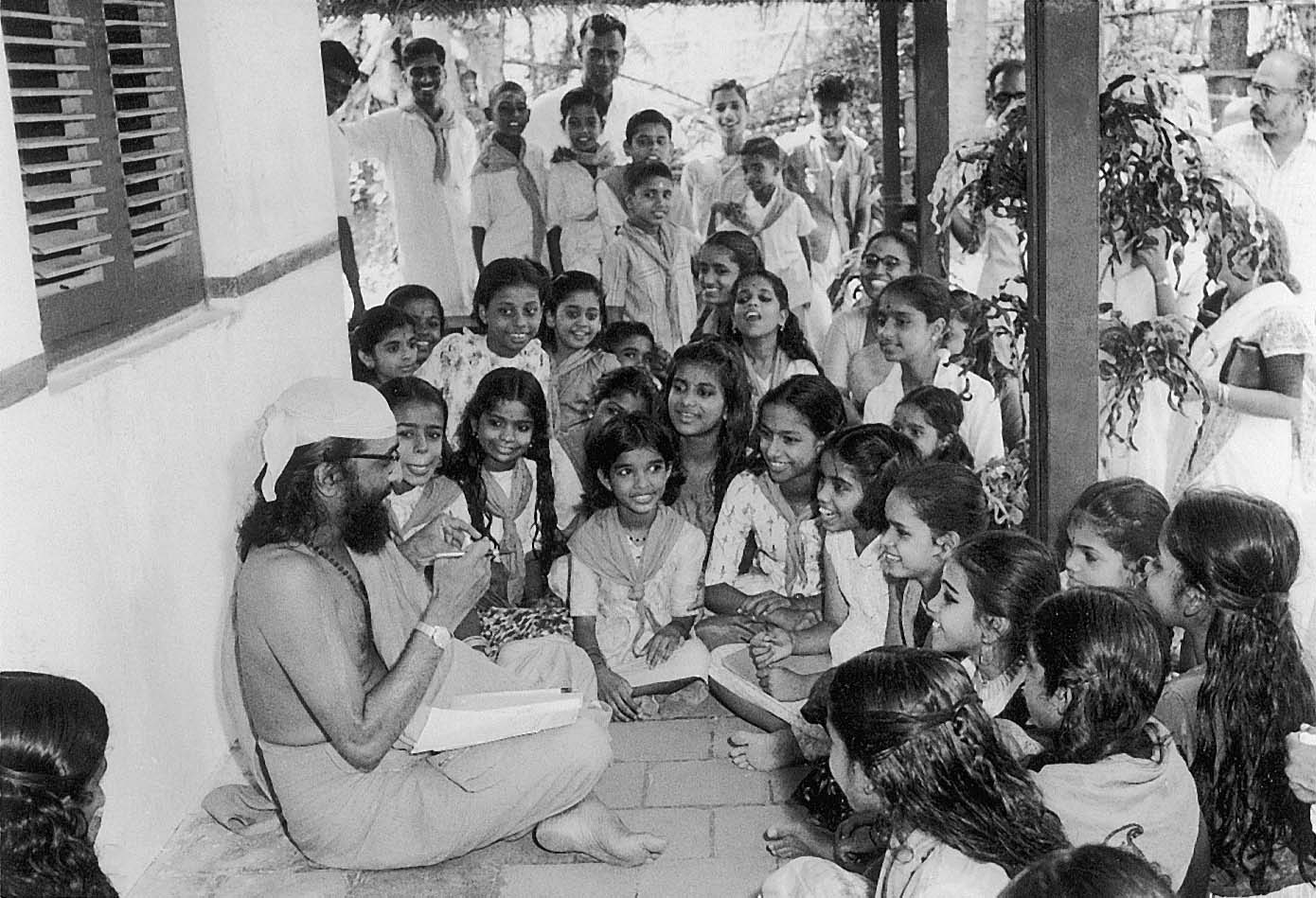
The clarion call that Gurudev made during the Hindu Renaissance drew not just the adults. Everywhere He went, the very young too felt that magnetic pull in His booming laughter, His cheerful spirit, and His extraordinary love. Naturally, in His Jnana Yajnas, a place was made to nourish the children, the future of Chinmaya Mission. With great love and care, the beautiful garden of Bala Vihar took shape first as the tender “Children’s Welfare” sections in different Chinmaya Mission centres during the late 1950s.
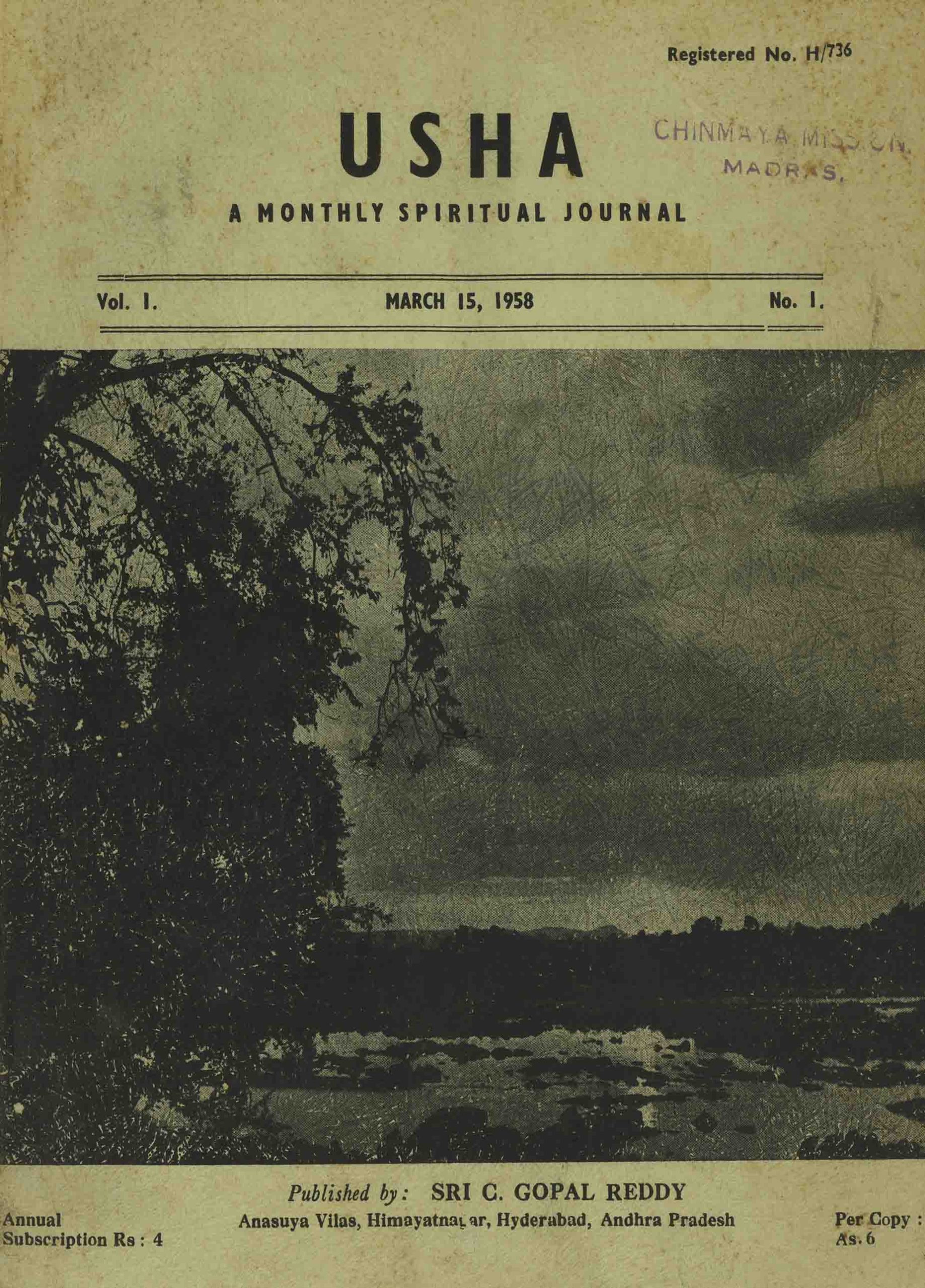
Named after the Hindu goddess of dawn, indicating a new beginning and revival, Usha, the monthly magazine of Chinmaya Mission had its first issue released on 15 March 1958. In the editorial Gurudev wrote, “It is time that the Groups must come together and their activities get somehow co-ordinated and systematized, each group drawing its inspiration from its sister-groups functioning elsewhere in India. USHA will be this messenger; she will contact all Groups by her awakening rays!”
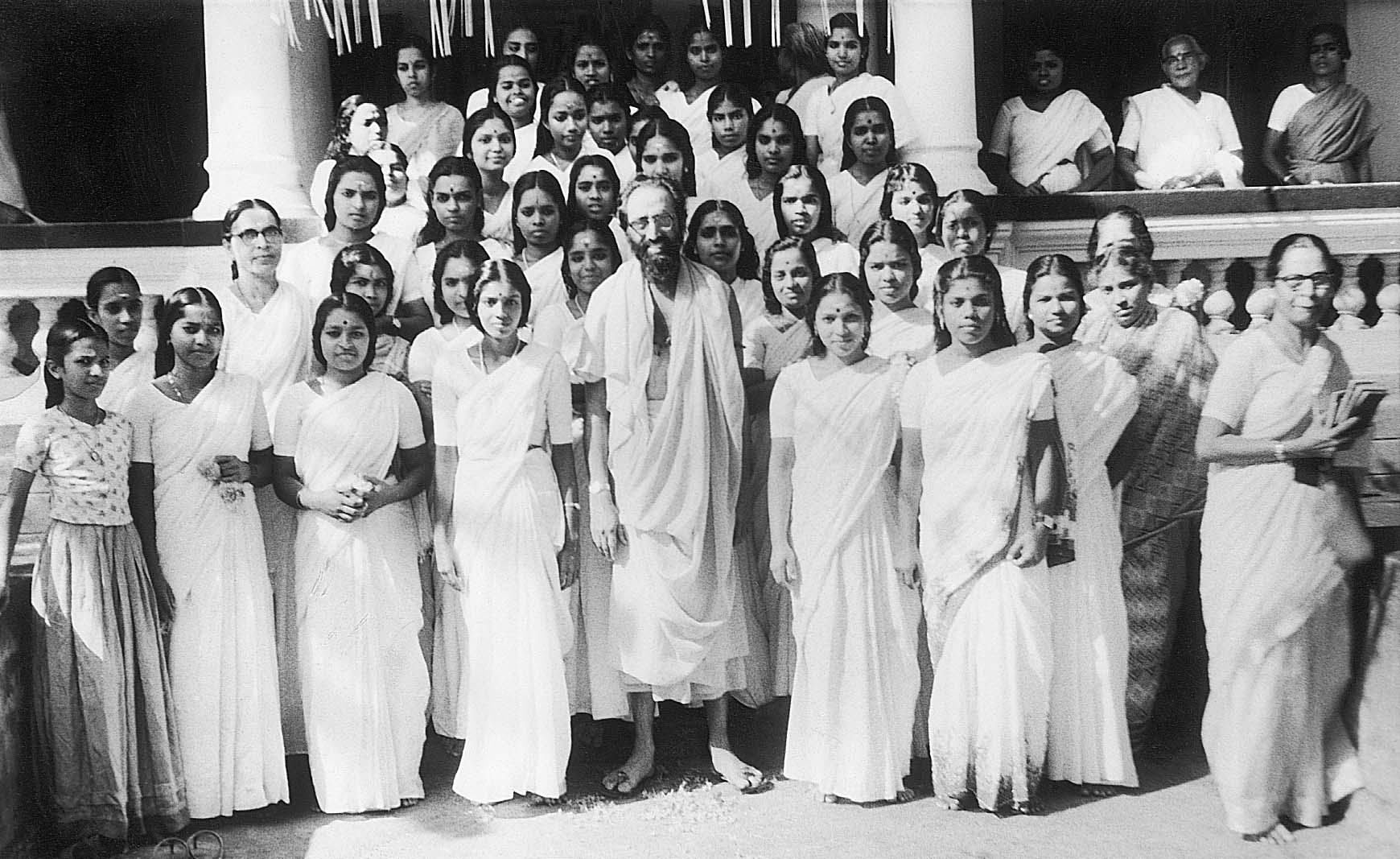
The spiritual inclination among women was strong, and Gurudev’s yajnas ignited a deep yearning to understand Vedanta more profoundly. It was time for the women of the expanding Chinmaya Family to build their own forum to gather and grow. Thus, on the Sunday of 2 November 1958, at Chinmaya Nilayam, 16 Harrington Road, Madras (now Chennai), the first Devi Group was inaugurated.
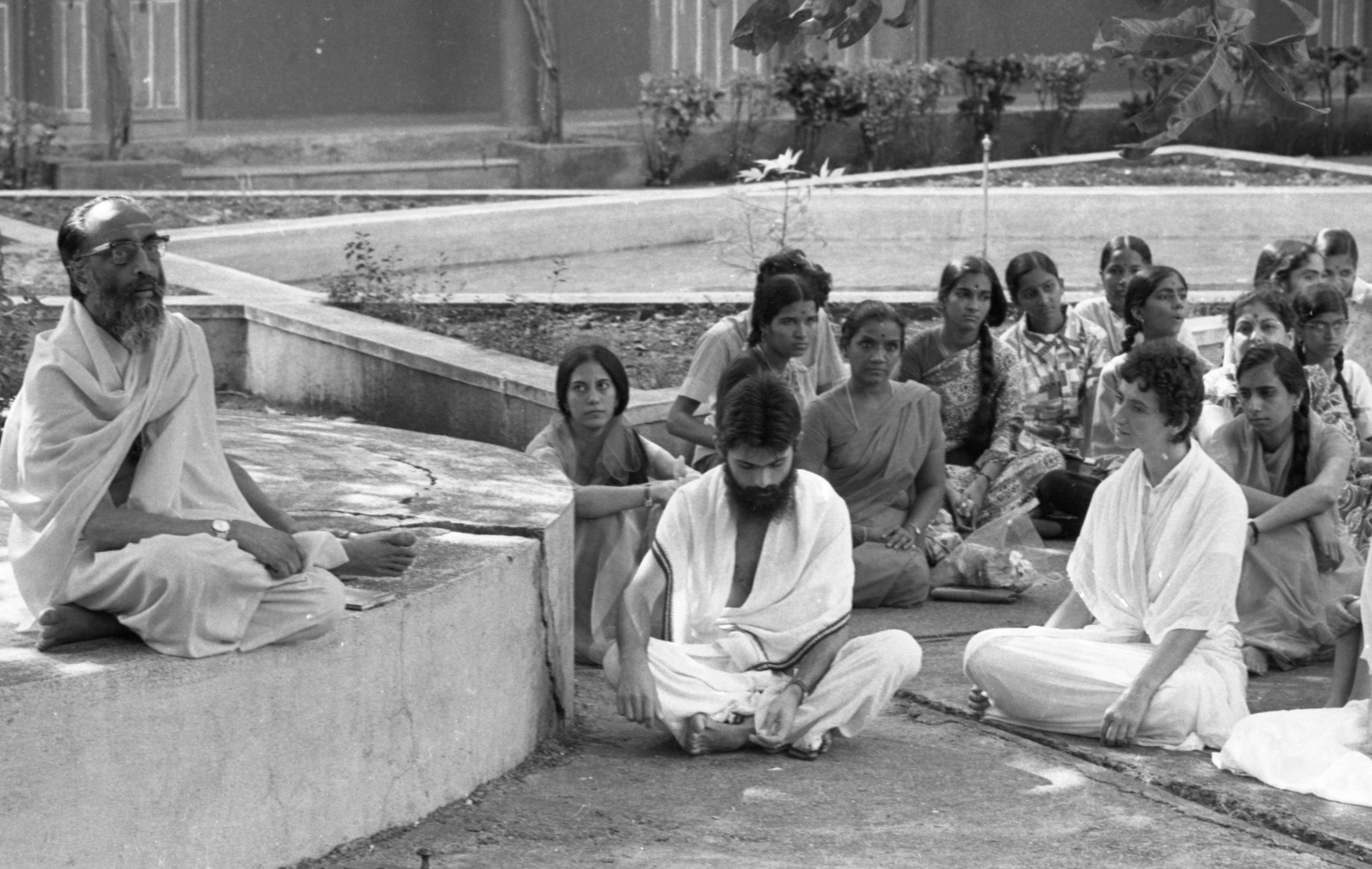
Gurudev envisioned Sandeepany Sadhanalaya, a Gurukula (residential academy) where the future torchbearers of Vedanta would be trained. Since 1957, he searched tirelessly for the perfect space to build an abode that would kindle the flame of perfection, as its very name suggests. Inspired by one of his powerful talks, a devoted seeker, Smt. Tara Sarup, offered her land in Powai, Mumbai, for this noble cause. Soon, the space for the first Sandeepany Sadhanalaya was registered on 19 January 1960.
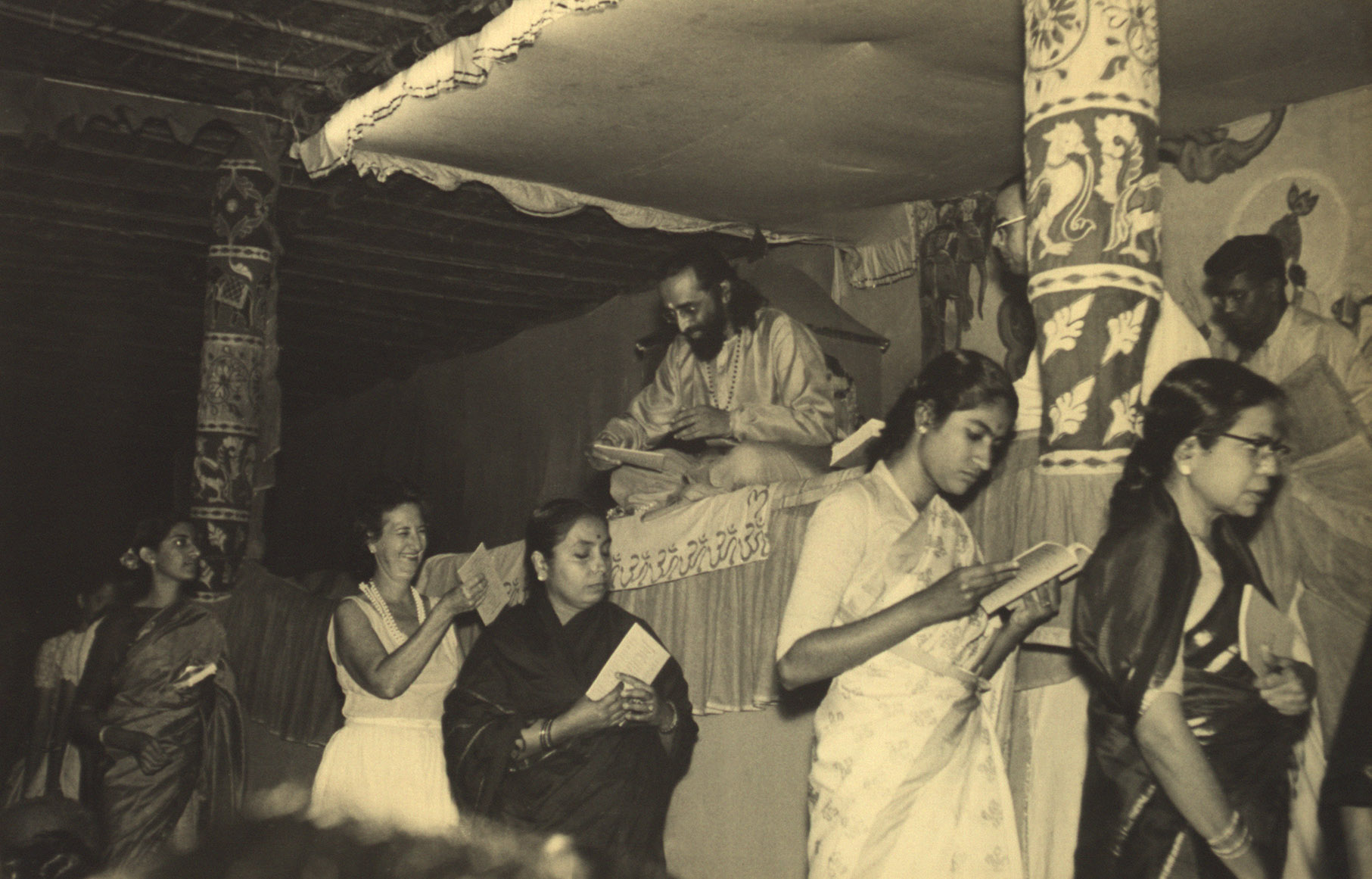
With His far-reaching vision, Gurudev launched the Chinmaya Publication Trust on 8 March 1961 in Madras, handing about 59 books authored by him for future publications. Over the years, the Trust became the precursor for the prolific Chinmaya Publications numbering over 900 titles currently. What started with books, now has additional categories such as pen drives, audio CDs, video DVDs, monthly magazines under the Chinmaya Mission (CM) banner, and CM-themed gifts.
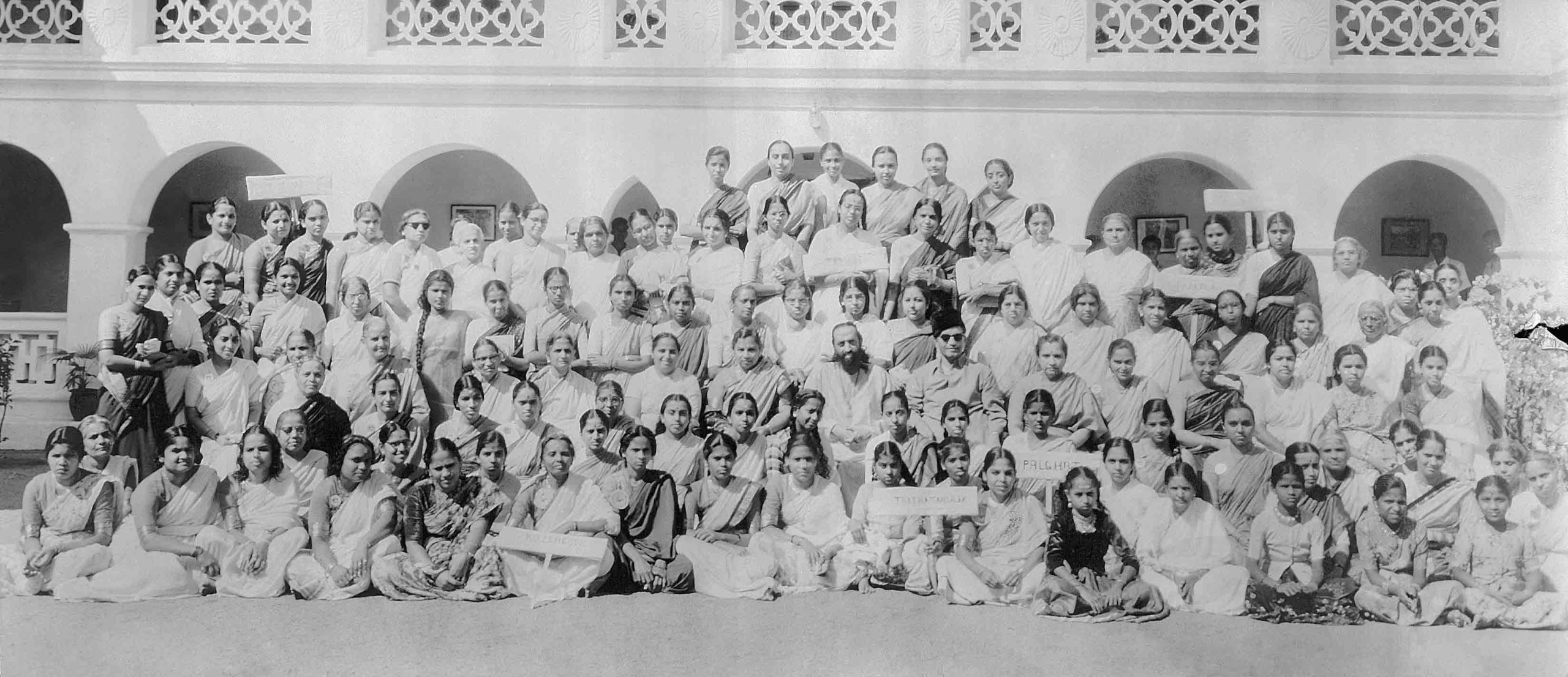
In His opening address at the Centenary Jnana Yajna (1 February – 2 March 1962) Gurudev said, “It is very auspicious to find that the women of Madras, as a Committee of ladies, are organising the hundredth yajna….In this 100th yajna, we will go one step further. We will not so much as discuss how to tune up our instruments of the mind and intellect; we will see what exactly is the Divine Centre in each one of us.”
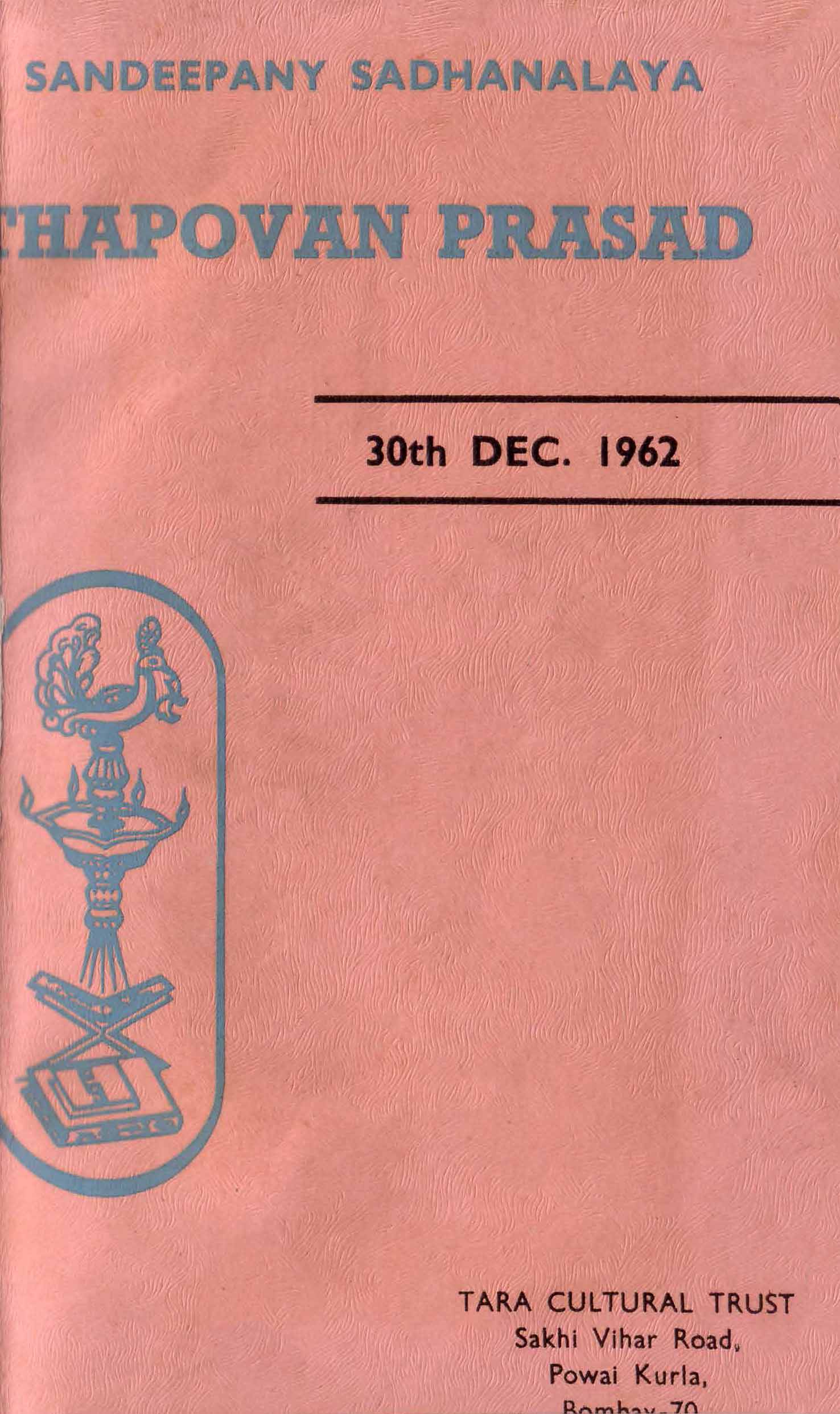
On 30 December 1962, Tapovan Prasad, the first official journal of Chinmaya Mission, was published by Tara Cultural Trust. Its very name indicated that all the work of Chinmaya Mission was an offering unto Parama Guru Swami Tapovan Maharaj. Right from its launch, Tapovan Prasad has reflected the growth and vision of Chinmaya Mission, offering a monthly overview of its spiritual and organisational activities. The magazine’s motto from the Bhagavad Gita, “O Kaunteya! Know for certain – My devotee shall never perish,” is a powerful reassurance to every seeker.
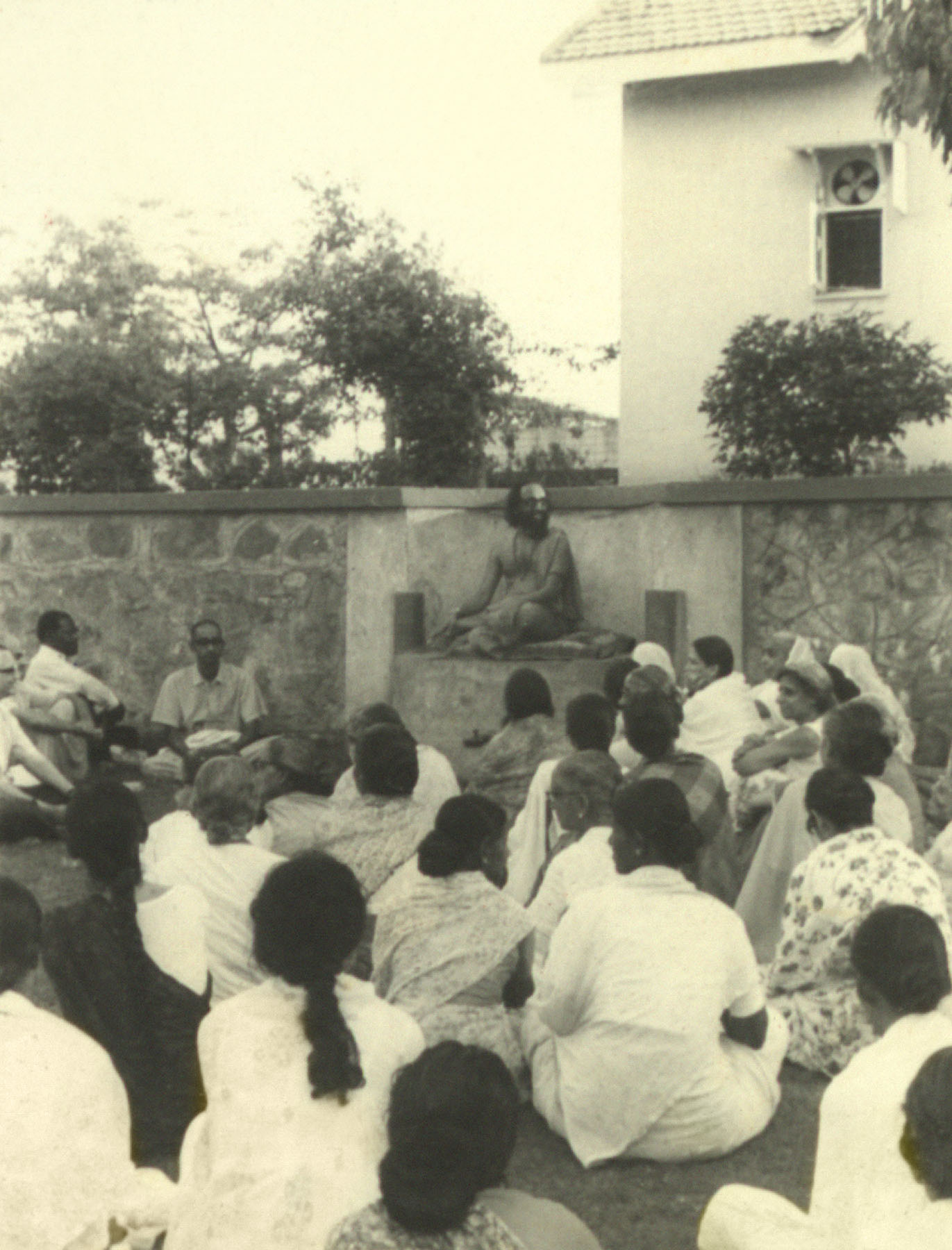
On the shores of the Powai Lake in Bombay (now Mumbai), to fulfil Gurudev’s vision of a future army of Rishi Putras or Hindu missionaries, the first Vedantic Institute was inaugurated with His opening address: “On Tapovan Day, January 9,1963, the Sandeepany Sadhanalaya shall come to light….This Sadhanalaya stands for the revival of our glorious culture, a culture that will run as a golden chord, binding us all as one people of divine nobility and spiritual brotherhood.”
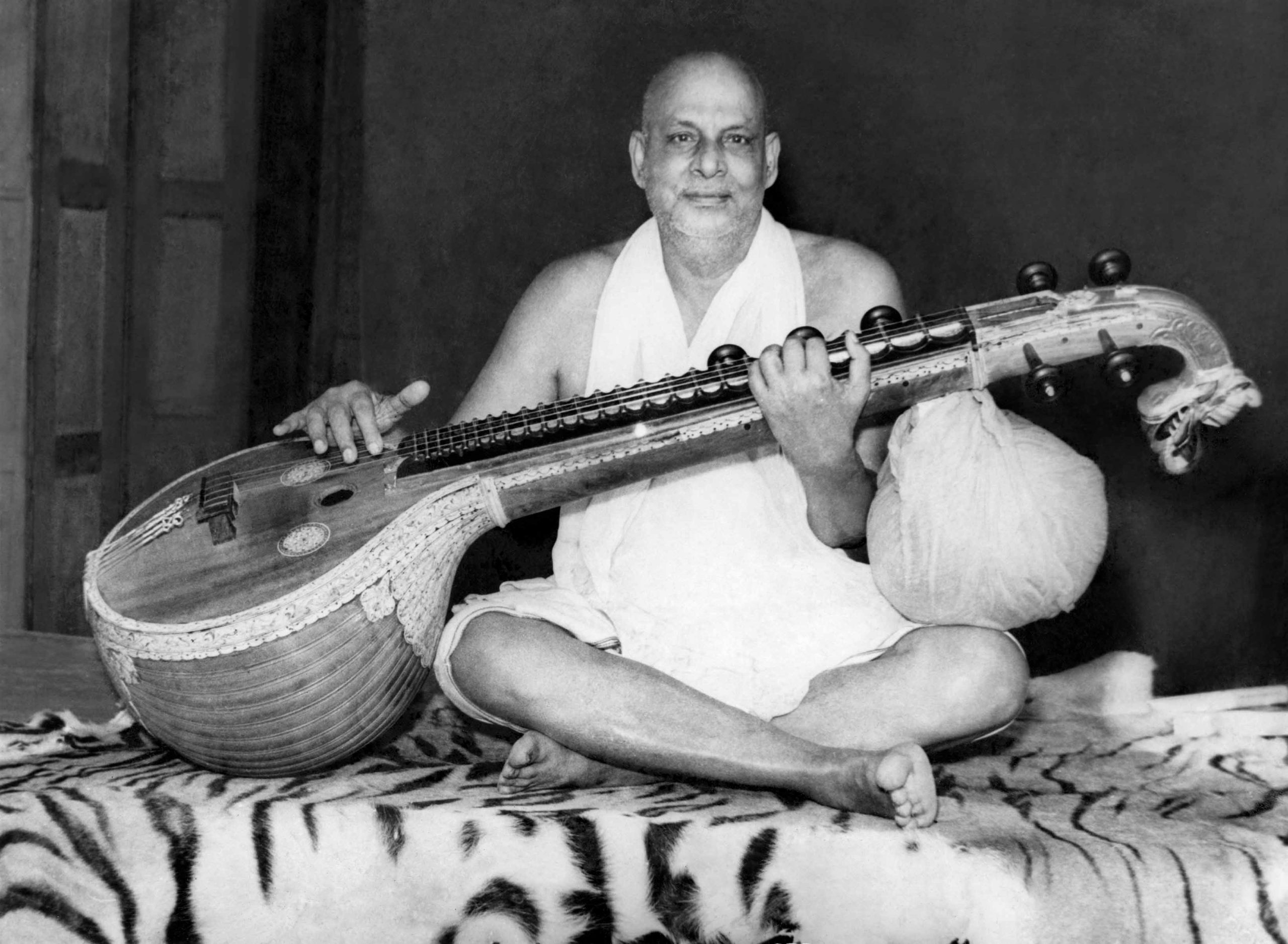
An exemplary Karma Yogi who truly lived the ideology of “Serve, Love, Meditate, Realize,” Swami Sivananda of the Divine Life Society, Rishikesh, attained Mahasamadhi on 14 July 1963. He was the dynamic sage who turned Balakrishnan Menon, a skeptic journalist, into Swami Chinmayananda, the charismatic Jivanmukta, by initiating him (Diksha) into sannyasa on 25 February 1949. When Gurudev heard the news of the Mahasamadhi of His Diksha-Guru, He undertook a tapovrata – severe austerities that lasted a whole year.
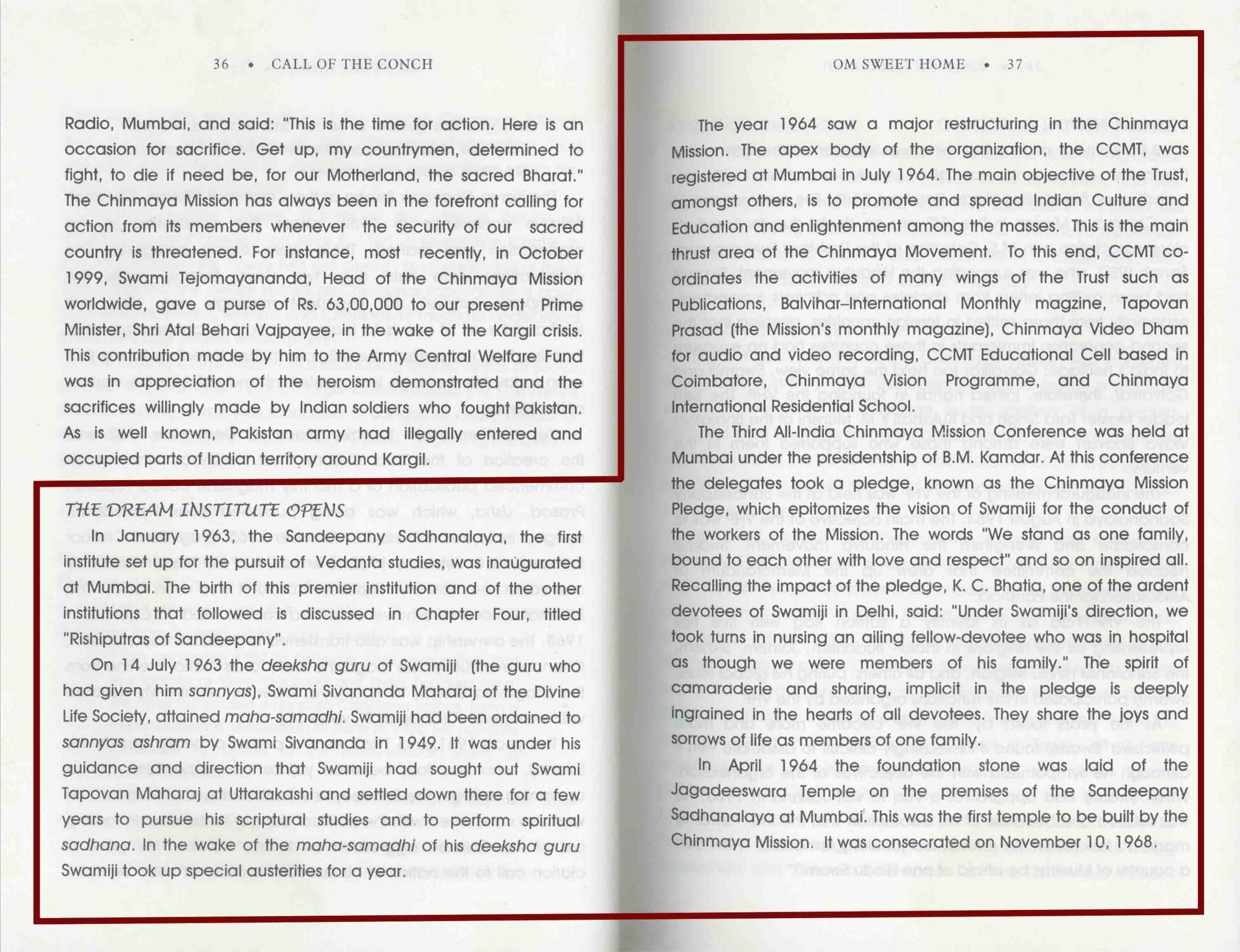
To streamline the expanding activities, Central Chinmaya Mission Trust (CCMT) was establsihed on 27 June 1964. Working for the organisational development of the Mission, CCMT serves as the head office and the governing authority, ensuring coordination across the various wings and global branches of Chinmaya Mission.
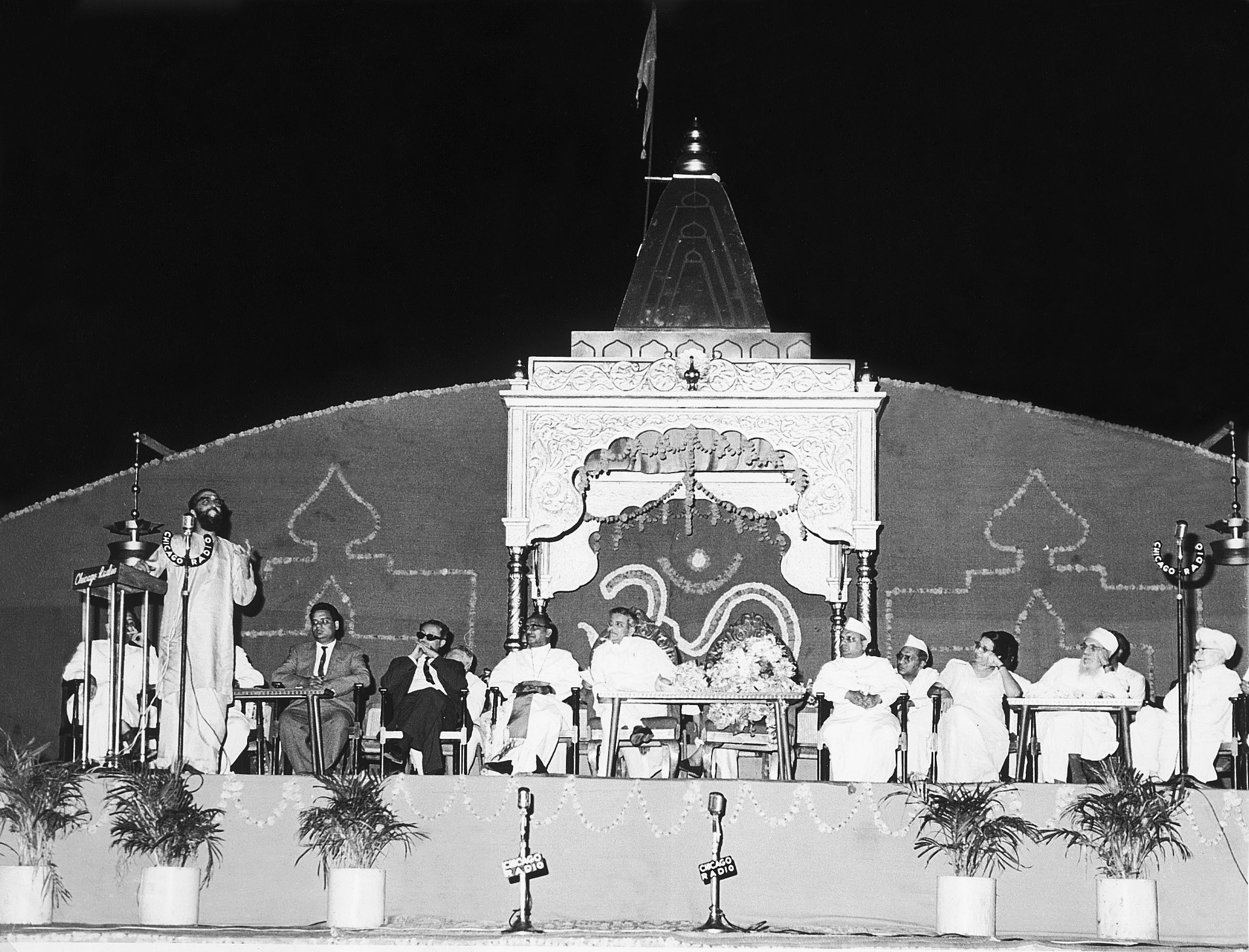
The plan for Vishwa Hindu Parishad (VHP) was developed on 29-30 August 1964, in the sacred ashram of Sandeepany Sadhanalaya, Mumbai, around the auspicious time of Krishna Janmashtami. Named “Vishwa Hindu Parishad” to spearhead a World Hindu Convention in 1966, it was envisioned as a spiritual and cultural body with no political affiliation. Gurudev, as the first acting President, welcomed over sixty delegates from the different branches of Hinduism to unite, spread, and strengthen the Hindu values of living worldwide.
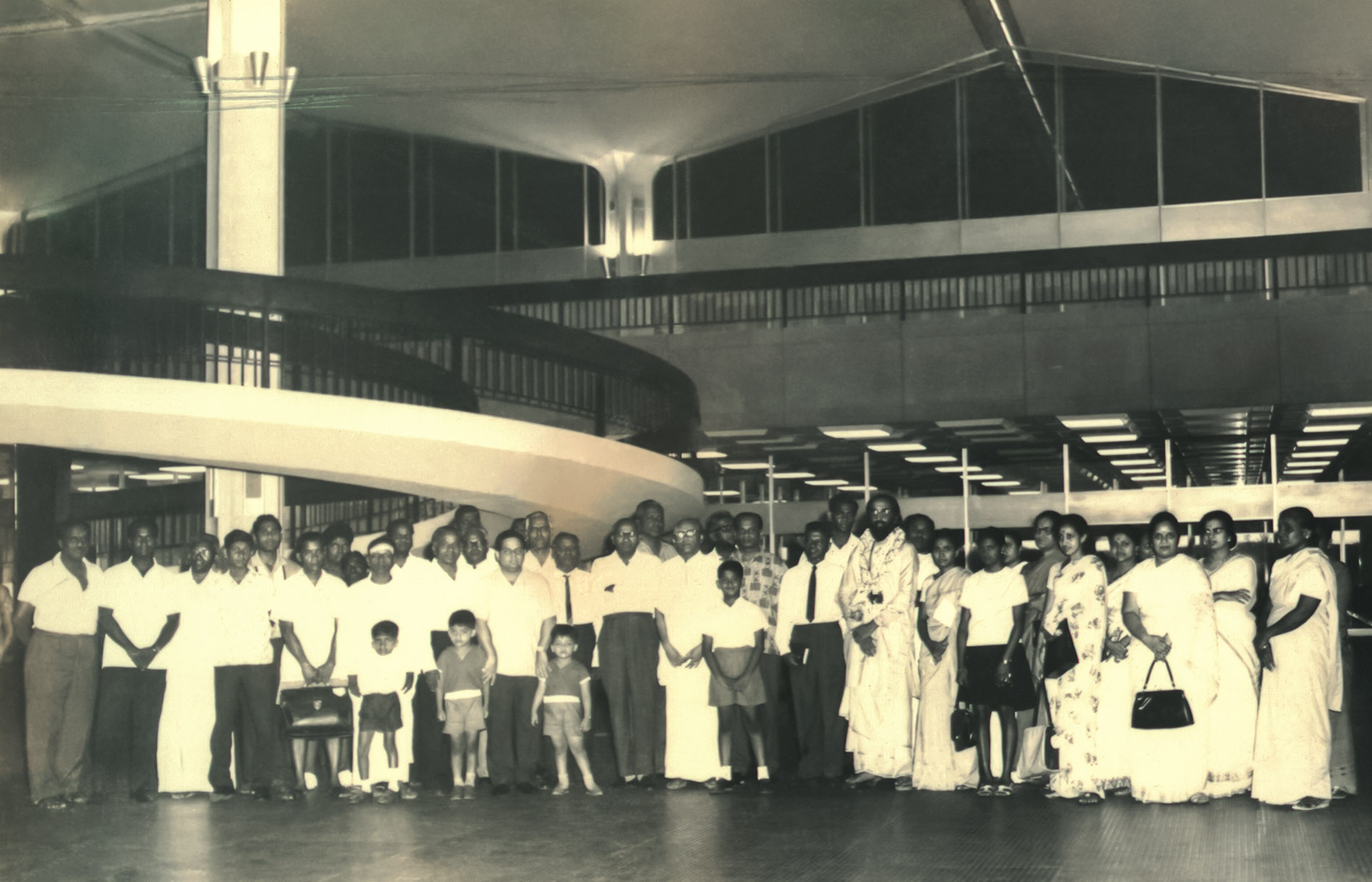
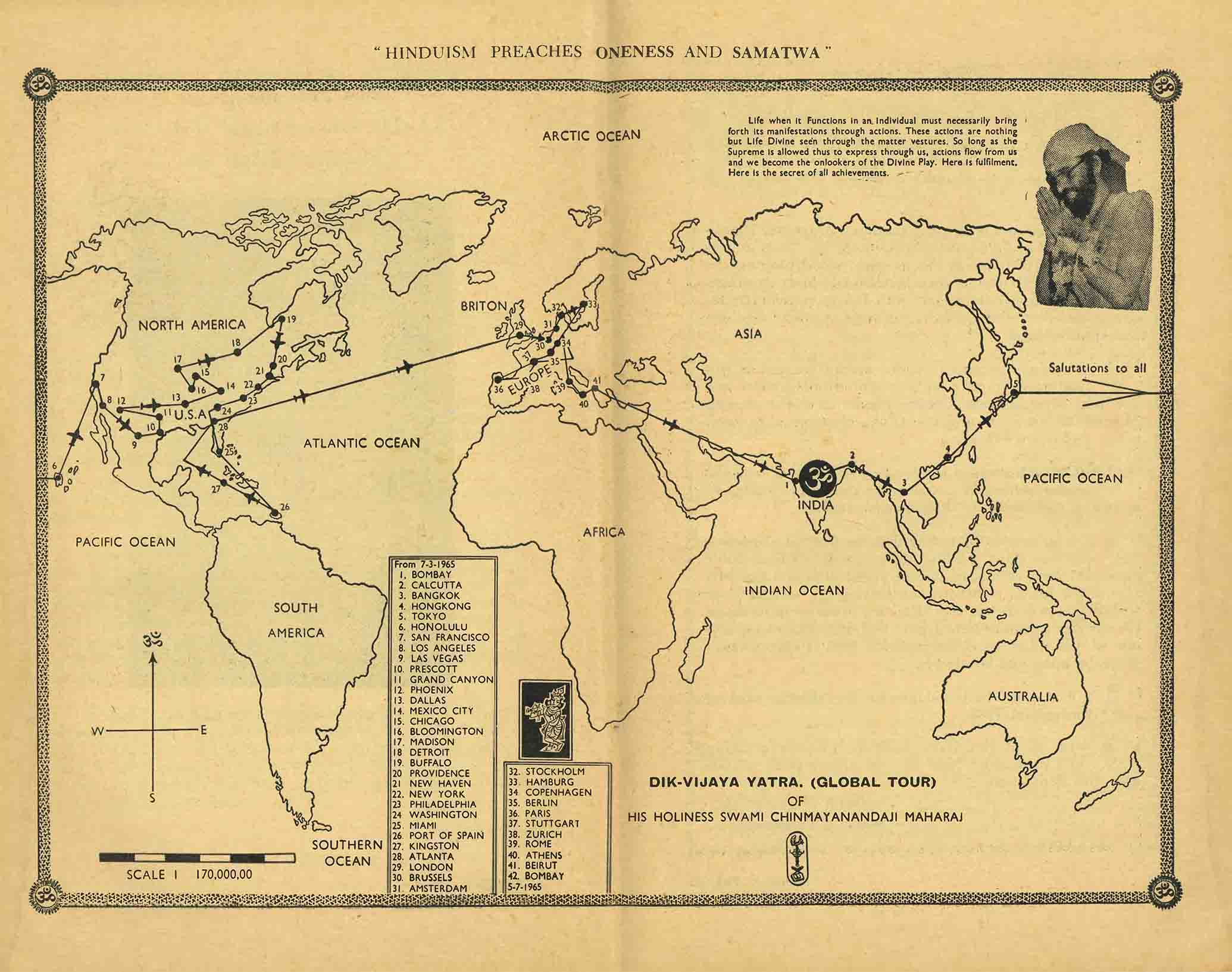
Gurudev’s first global tour (7 March – 24 June 1965) carried the essence of Hinduism and its universal applicability. He said, “With a heart full of love for all mankind, we undertake this pilgrimage to see Him in all and to show to all, Him who is in the heart of everyone.” In under four months, Gurudev’s tour covered three continents and 39 cities, paving way for 26 more world tours until His Mahasamadhi in 1993.
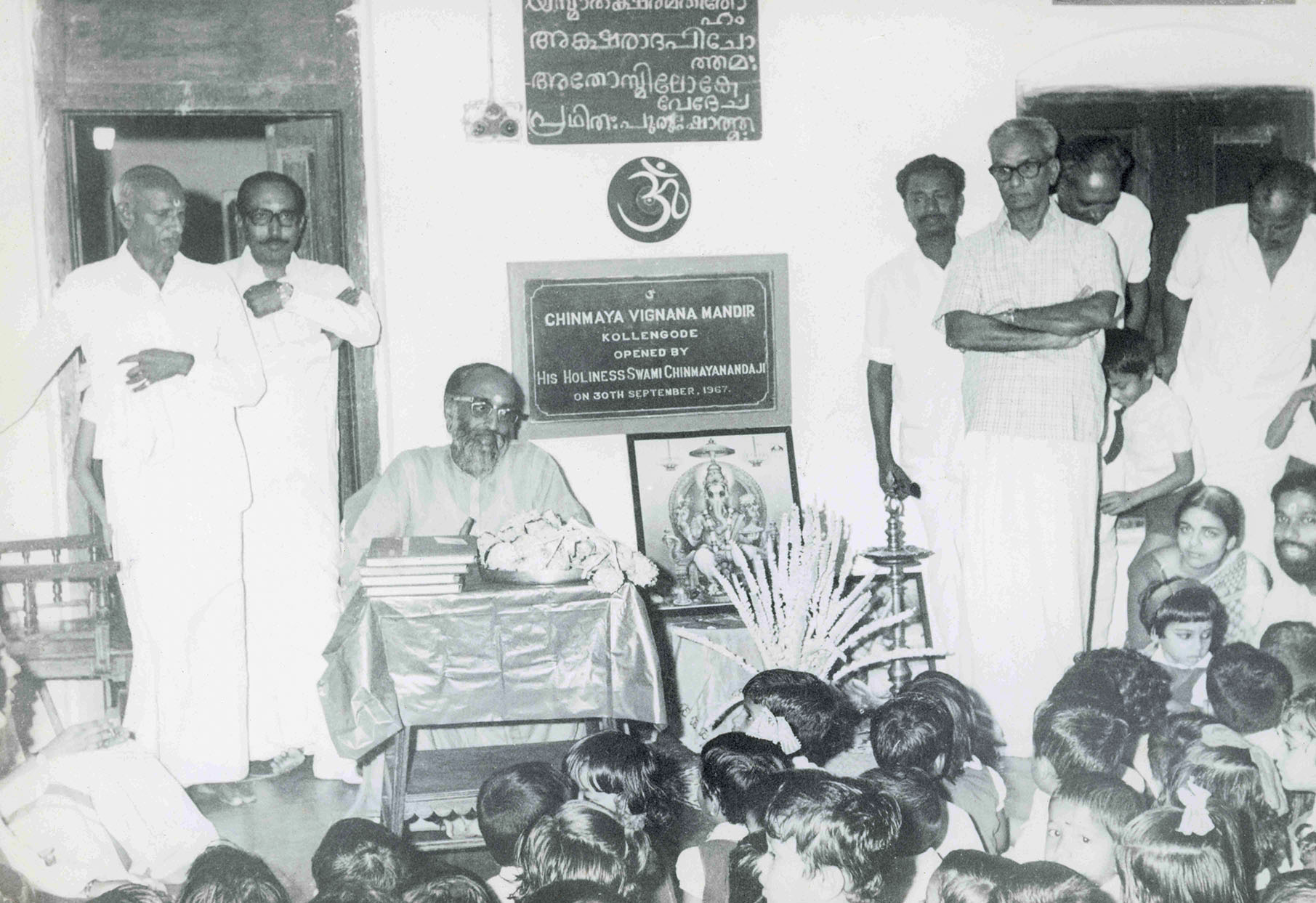
Guided by Gurudev’s vision for value-based education, the first Chinmaya Vidyalaya was established as a nursery school in Kollengode, Kerala. The Queen of Vengunad, Radha Devi Namboodiripad, generously offered part of her palace grounds, and K.P.S. Menon, former ambassador to Russia, lent his support as a patron. Today, the CCMT Education Cell oversees 81 Chinmaya Vidyalayas across India, one in Trinidad, 9 Chinmaya Colleges, and 14 Chinmaya Vision Schools, continuing to nurture generations with knowledge and values.
To address the challenges of distance, time, and access, Gurudev launched the postal tuition course on the fundamentals of Vedanta in 1966. This course laid the foundation for the many long-distance learning programs developed by Chinmaya Mission in the years to come. Remarkably, until His Mahasamadhi, Gurudev personally responded by correspondence to every doubt and question raised by students, making the learning experience deeply personal and enriching.
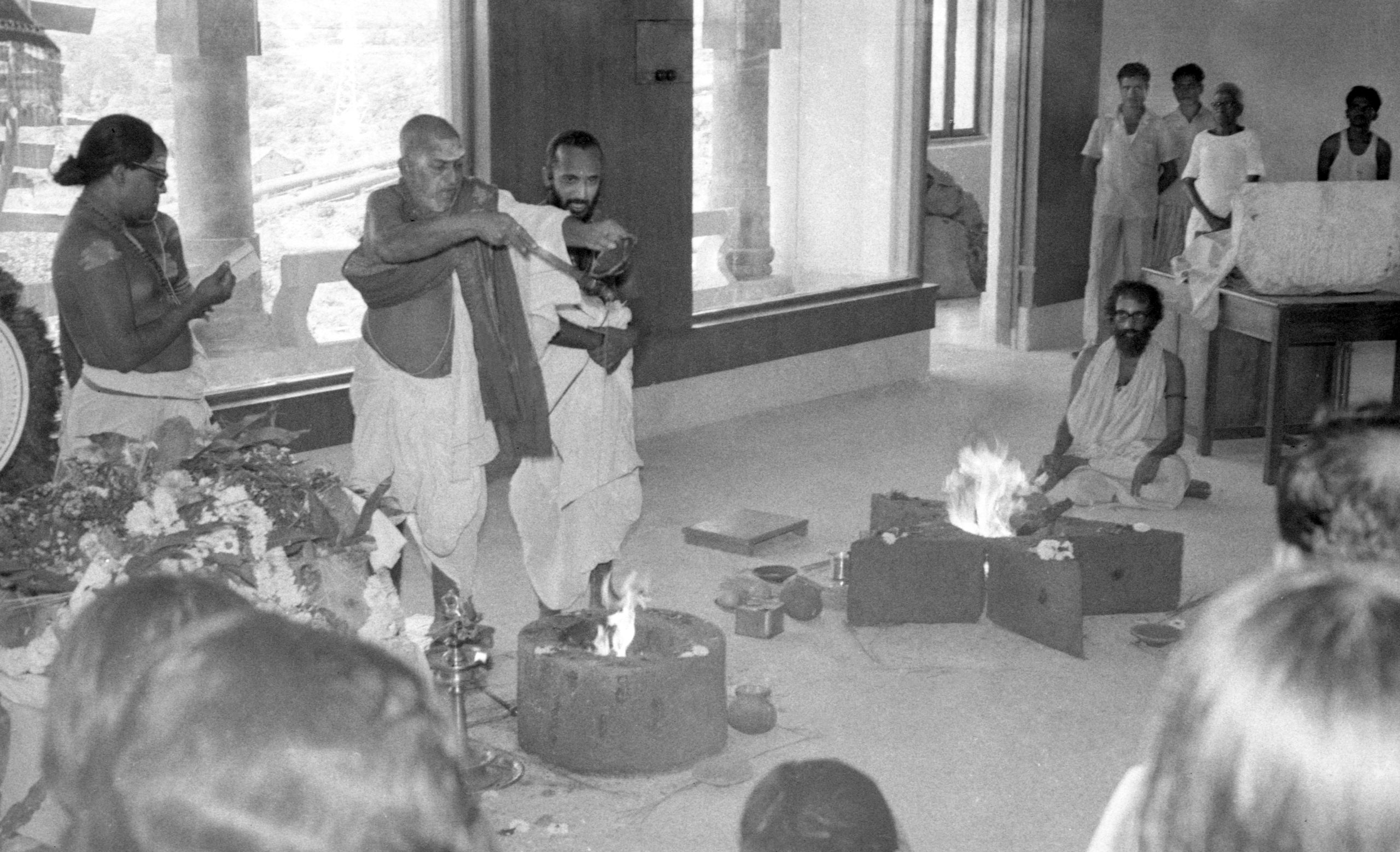
On the auspicious day of 10 November 1968, Lord Siva was ceremonially invoked at the inauguration of the majestic Jagadeeshwara temple on the top of a hillock in the tranquil grounds of Sandeepany Sadhanalaya, Mumbai. Gurudev with his scriptural knowledge, guided the inauguration and installation ceremony. The Kalasha Puja with the holy waters of the Ganga straight from Gomukh was followed by a sacred anointing of the idol of Lord Siva with the other divine idols.
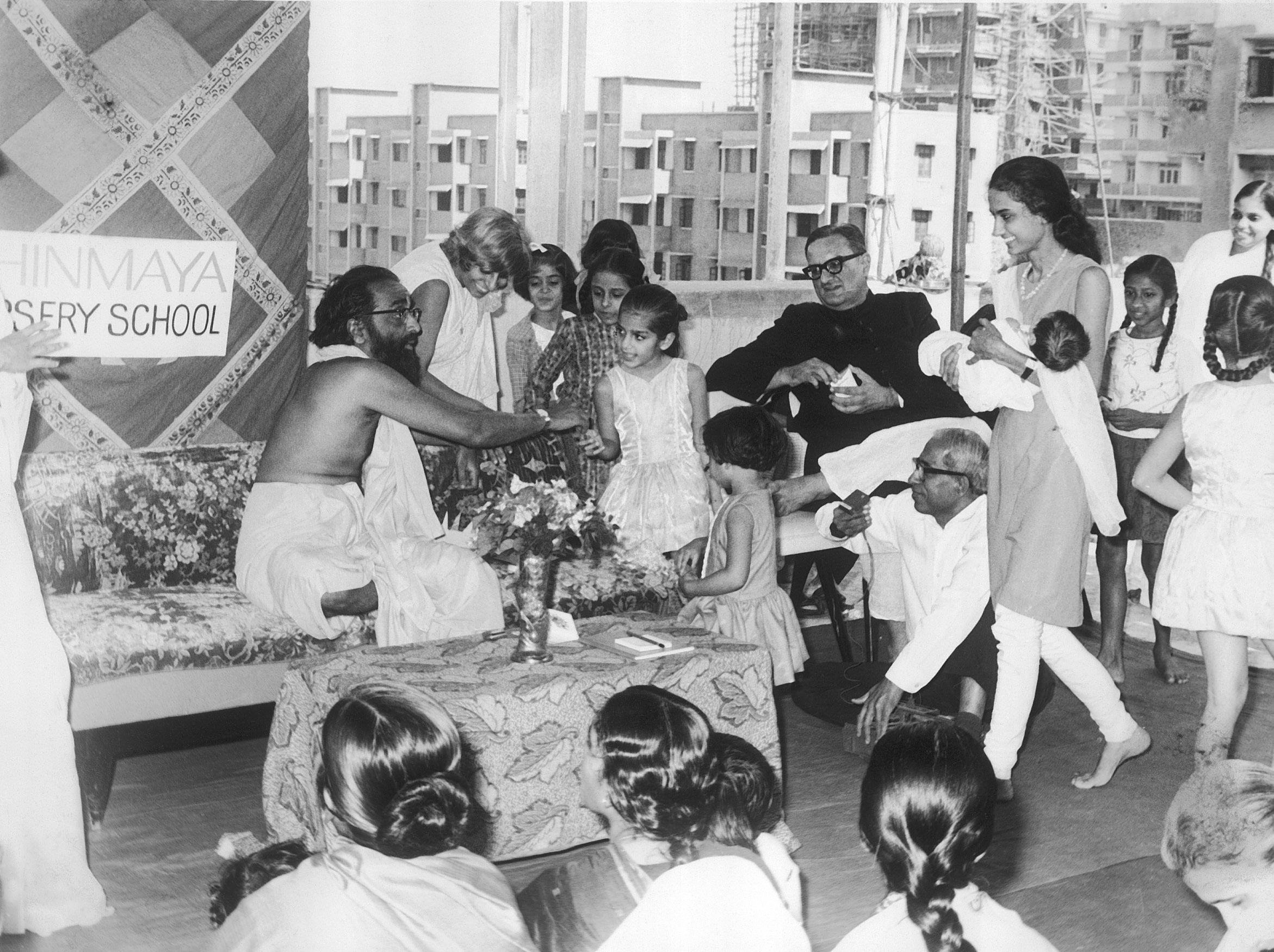
In the bustling city of Bombay (Now Mumbai), another “preschool with a difference,” the 18th Chinmaya Nursery School opened at Kemps Corner. Following an earlier school started in Worli, Mumbai in 1967, at the inauguration, Gurudev was joyfully welcomed by the little children. He reminded the teachers to nurture them for a holistic outlook on life from a young age.
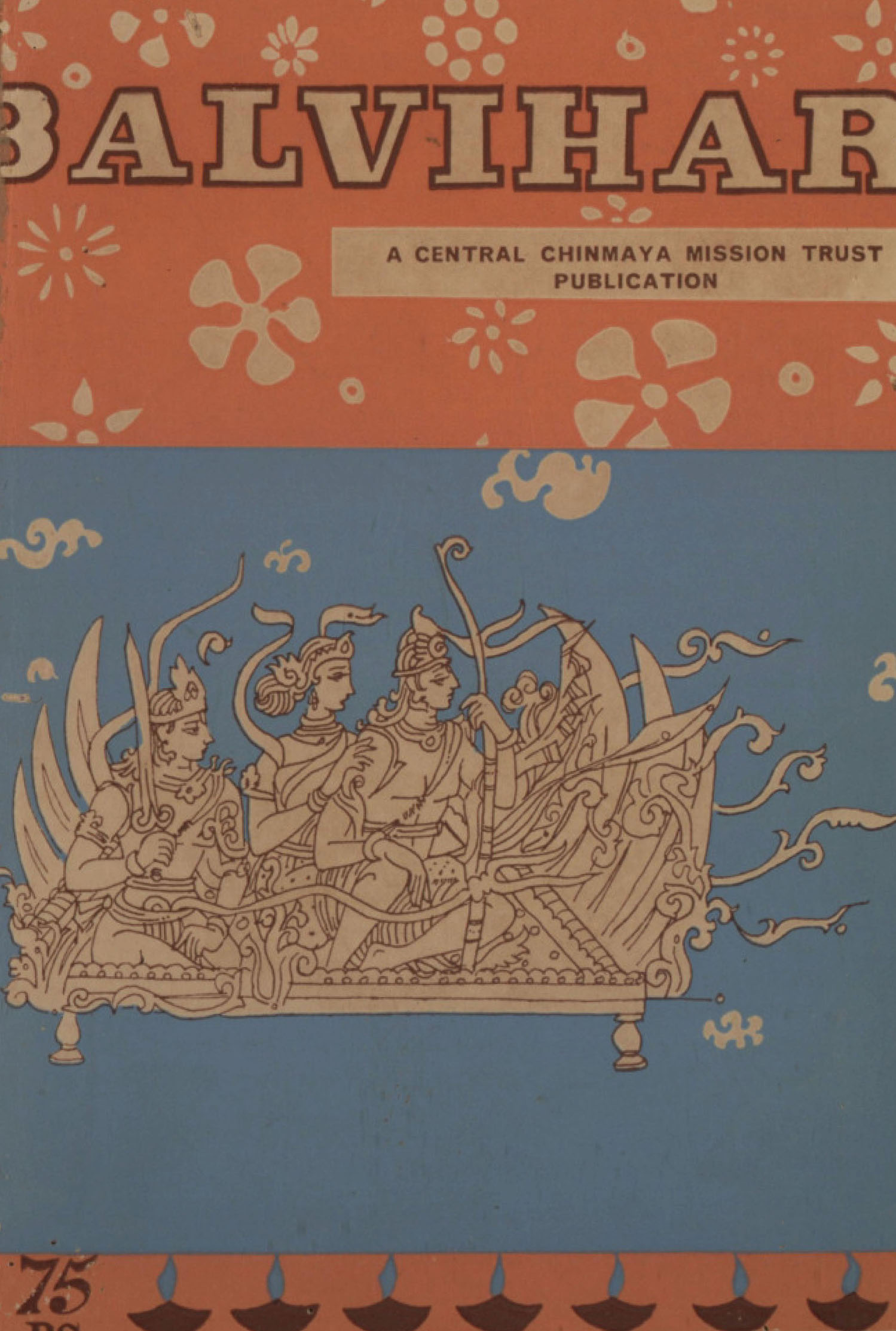
To connect the children across the world with love, learning, and laughter, a children’s international monthly magazine called Balvihar was released by Gurudev in November 1969. He wrote in the inaugural issue: “We shall, through this journal, build bridges of love and understanding between children everywhere, and we shall learn to create a greater world out of what our parents have given us now.” Since then, the pages of Balvihar have enriched countless children with joyful creativity, noble values, light-hearted moments, and knowledge both sacred and secular.
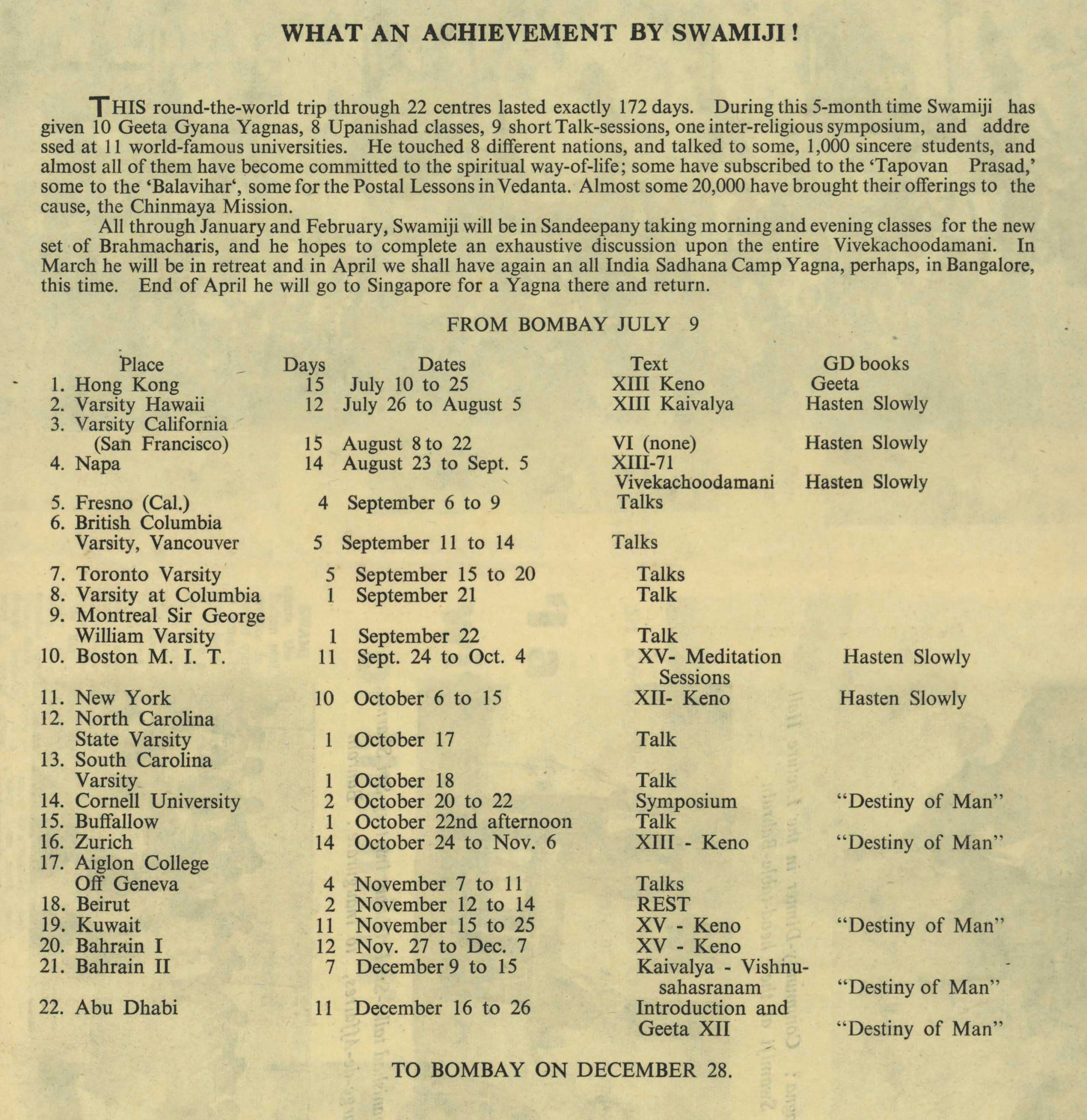
On 21 March 1970, Gurudev suffered his first heart attack in Mysore. Yet, undeterred, he resumed his mission, undertaking two intense world tours. These, his fourth and fifth global tours, carried him over 11,000 miles across the Middle East and Western countries, where his powerful ‘Chalk Talks’ (Vedanta in classrooms) captivated audiences and opened new doors of understanding for seekers worldwide.
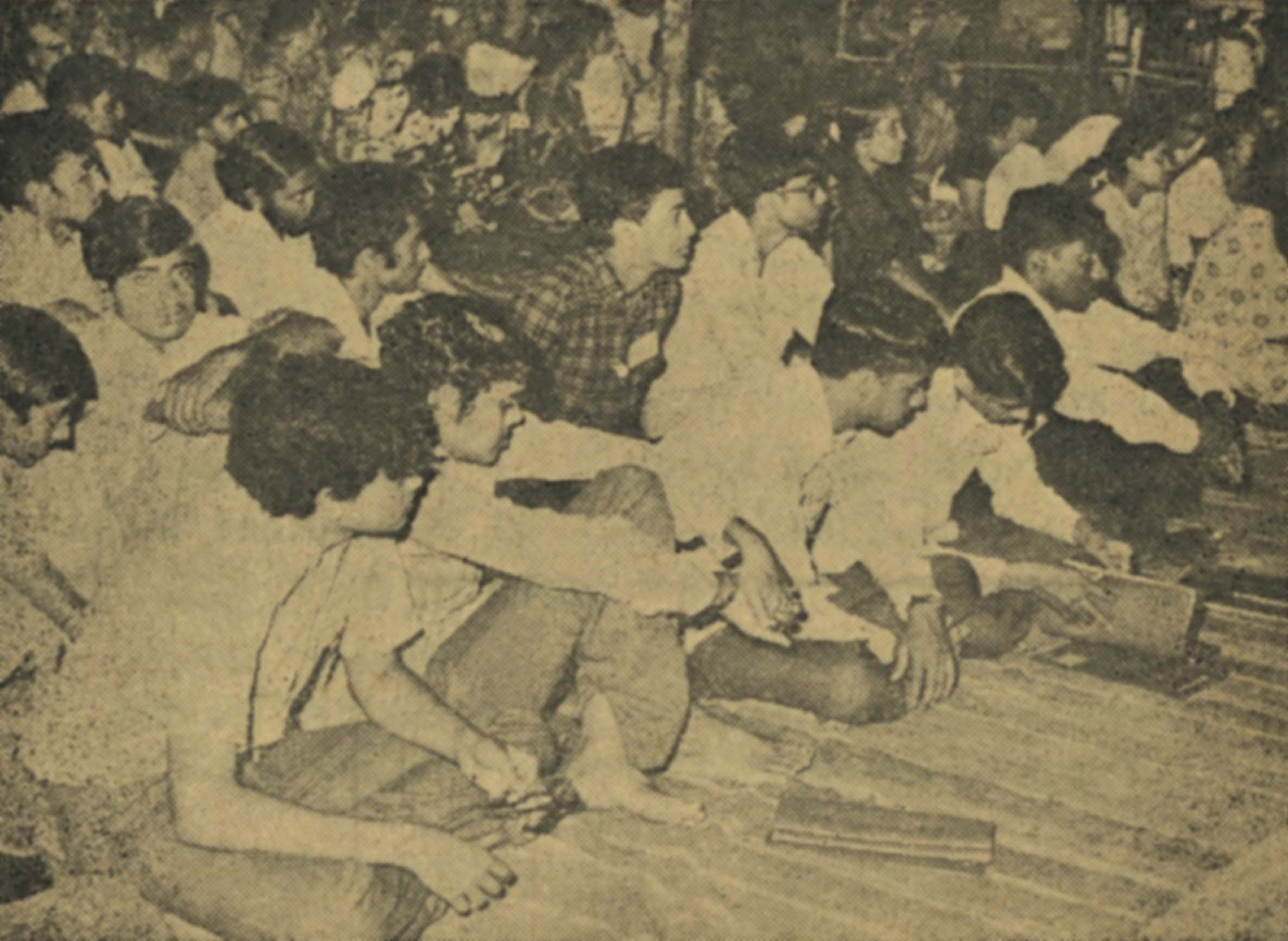
In May 1975, Gurudev lay foundation for Chinmaya Yuva Kendra (CHYK). From 20-27 May 1975, for the first time in a Gita Jnana Yajna, there was a special spiritual camp for youth and students. An important outcome of the camp was the formation of a Chinmaya Youth Forum with Bangalore as the headquarters. That forum became Chinmaya Yuva Kendra (CHYK) to emphasize that its main goal was its spiritual potential and not political affiliation.
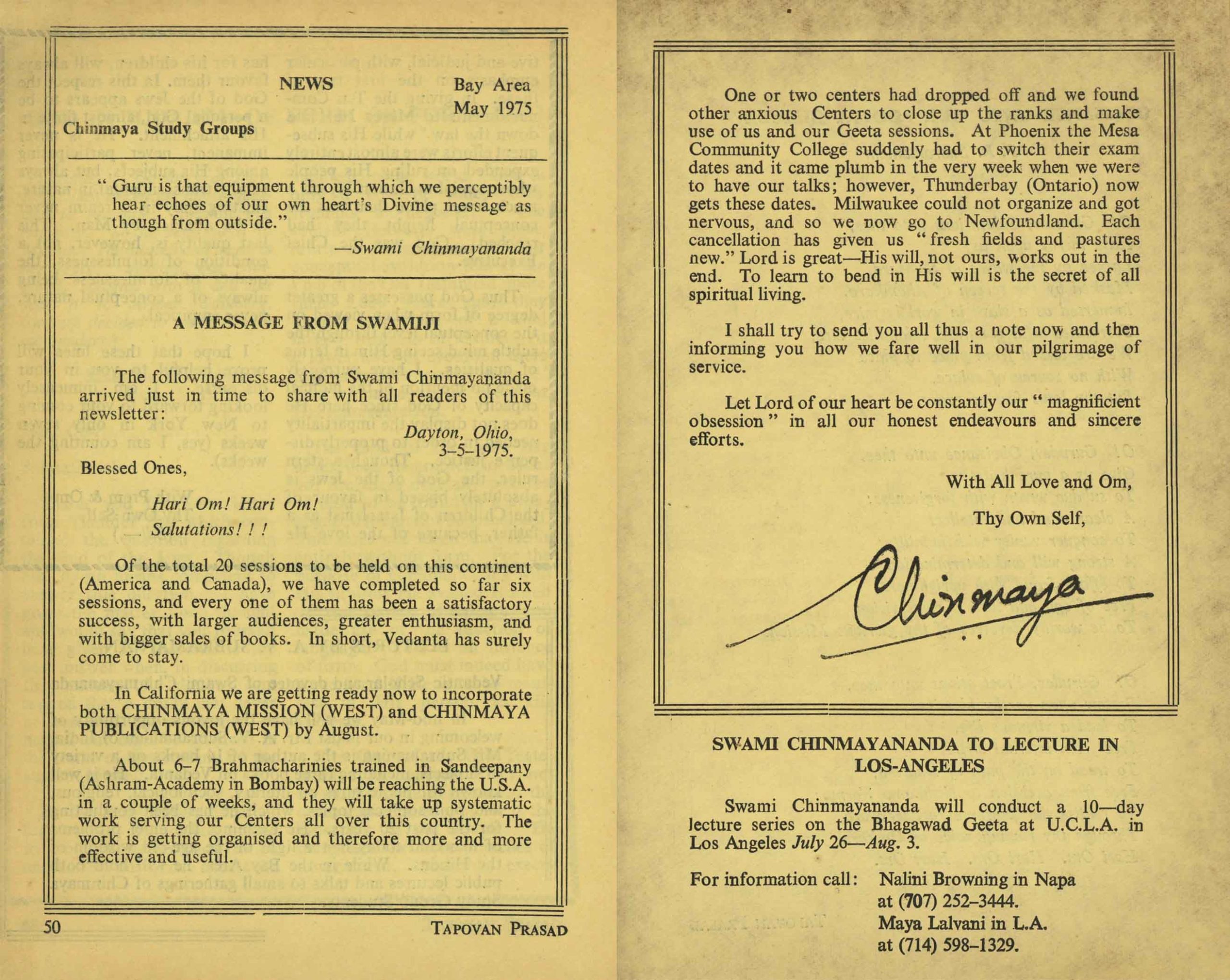
To unify the rapidly growing Chinmaya Mission centres in the United States with a common vision and structure, Gurudev established an apex coordinating body – Chinmaya Mission West (CMW). It was incorporated as a nonprofit in the San Francisco Bay Area in August 1975. Alongside, Chinmaya Publications West (CPW) was founded as a separate nonprofit to meet the increasing demand for Gurudev’s books and publications, later becoming the publication division of CMW.
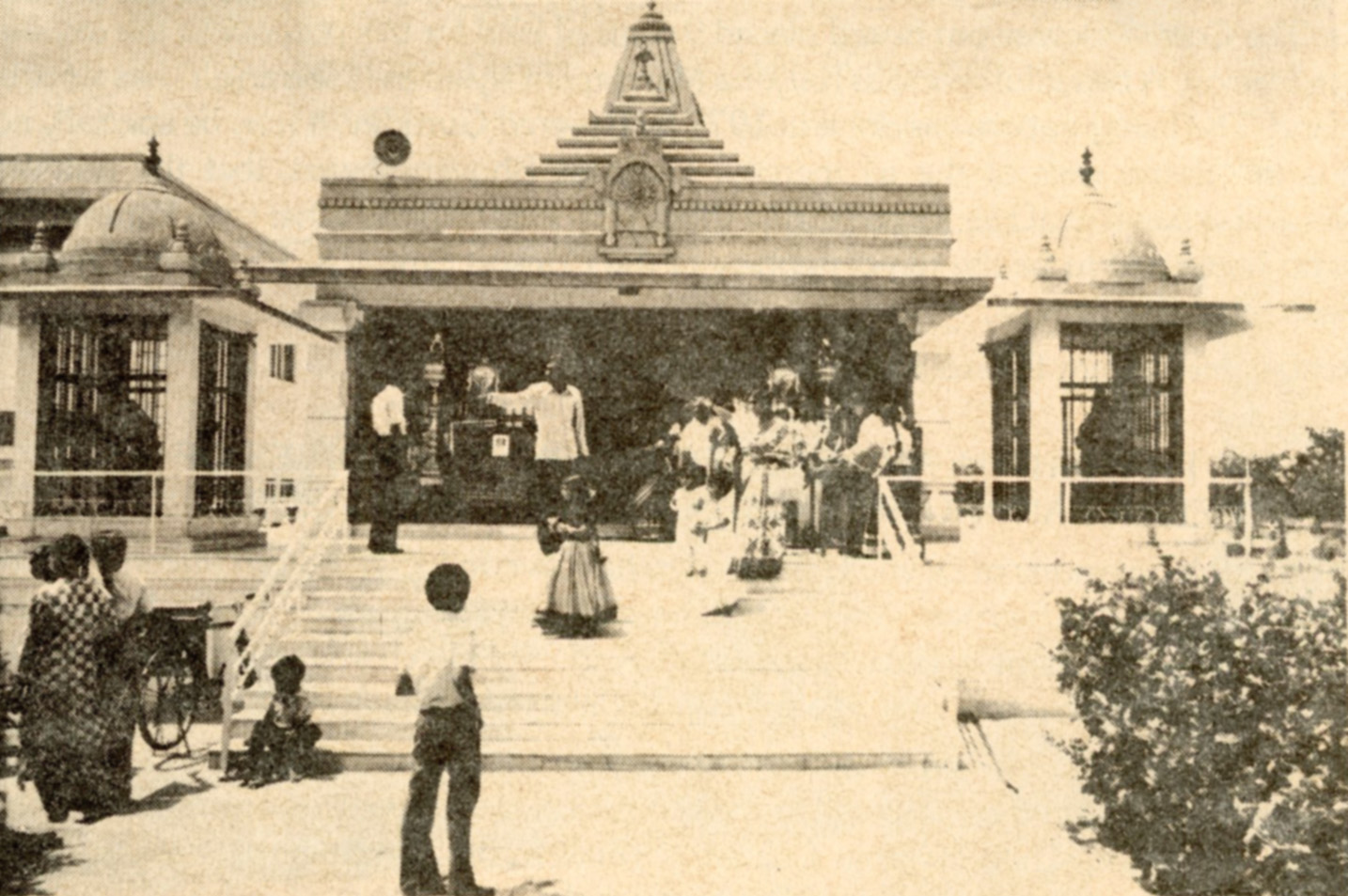
In March 1978, Gurudev consecrated a beautiful temple in Indira Nagar, Bangalore (now Bengaluru). Called Deenabandhu Devasthanam, the temple’s main deity is a captivating black granite idol of Lord Krishna in the Kaliya Mardhana pose. Gurudev revealed the symbolism: “Krishna is dancing on the serpent (the ego), which spits forth the poison (vasanas) into our life stream. Let us revere and worship Him whose Grace blessed us all, who is the Deenabandhu.”
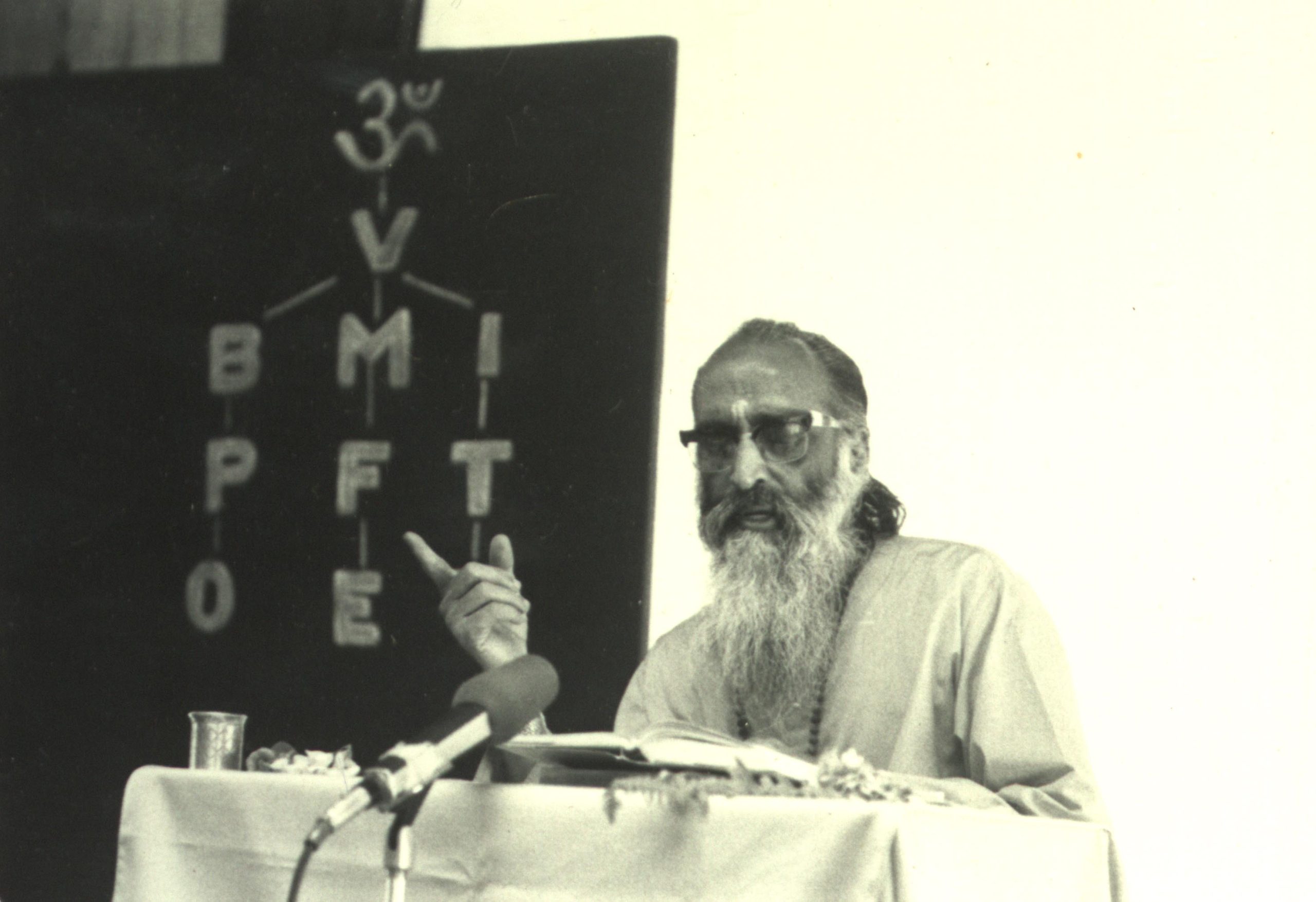
On 7 November 1979, Chinmaya Mission West (CMW) inaugurated its first Vedanta Course outside India (1979–81), with about forty-two students, at Krishnalaya Ashram in Piercy, California – the first property acquired by CMW. Gurudev fondly called it the “Sandeepany of the West.” Set amidst the serene beauty of Northern California, between the coastal mountains and towering redwoods with the Eel River flowing nearby, the ashram has since blossomed into a spiritual sanctuary.
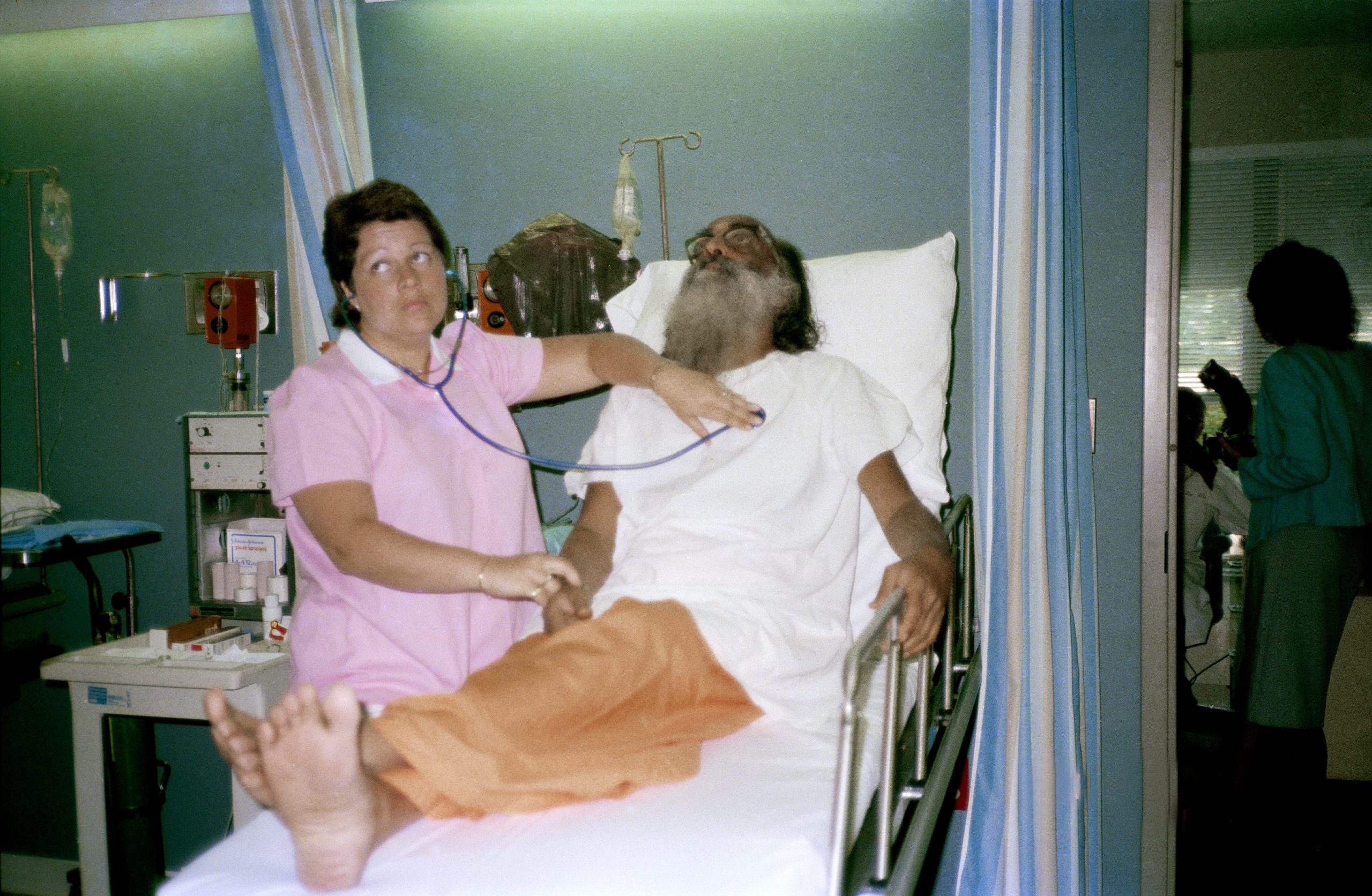
During His tour in the United States in 1980, it was discovered that Gurudev had more than 80% blockage of His four main arteries. He was immediately flown to St. Luke’s Hospital in the Texas Medical Center, Houston, where the renowned Dr. Denton Cooley and his team successfully operated on Gurudev, reviving and strengthening his heart for the sacred work ahead. The doctors wondered how He had carried on so long with such cardiac damage.
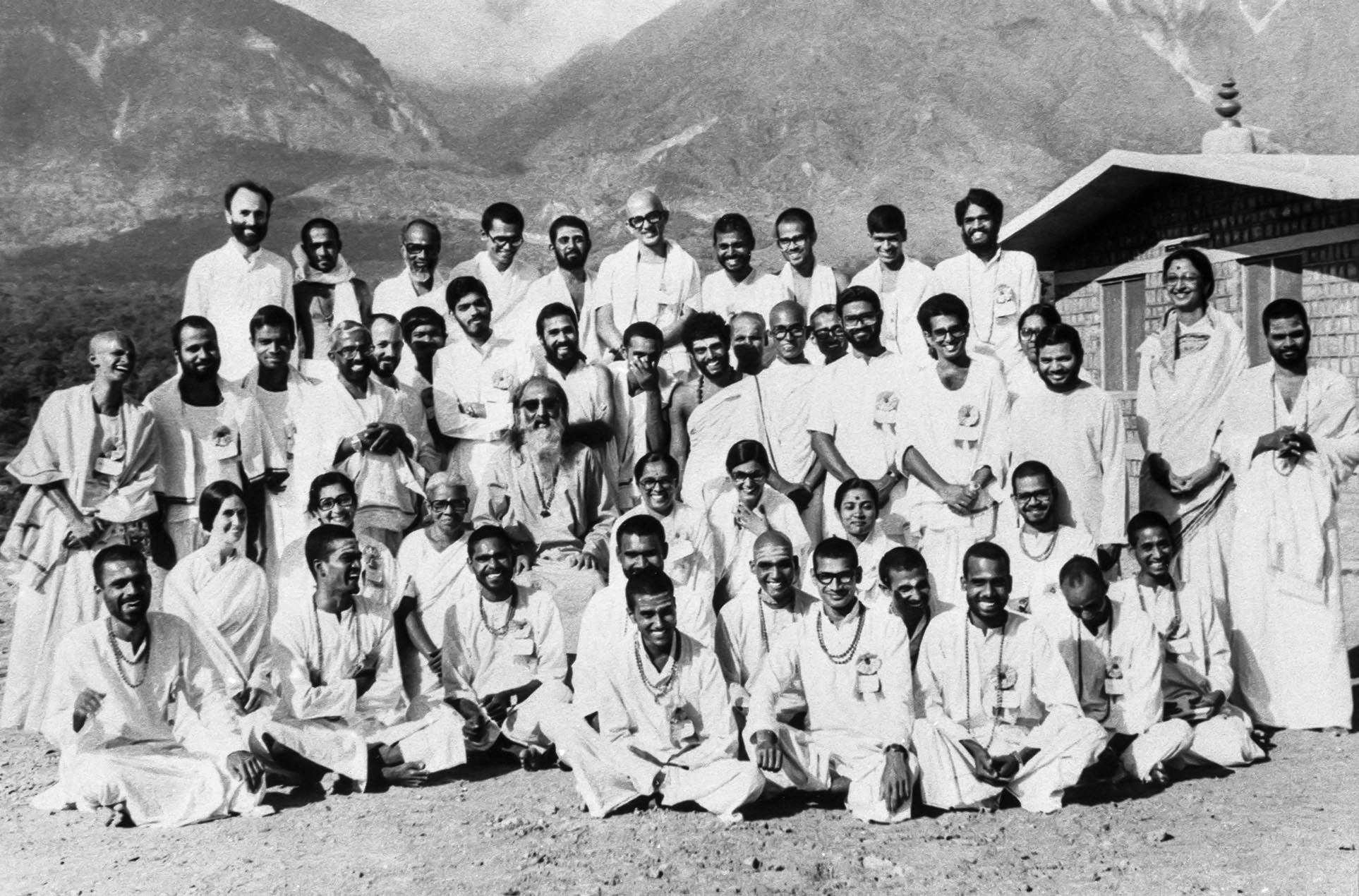
Sandeepany Himalayas (HIM) in the serene, sacred Sidhbari, commenced its first two-year Vedanta Course in Hindi after a memorable inaugural ceremony on 25-26 April 1981. Located between Dharamsala and the Yol Cantonment in the lush Kangra Valley, crowned by the snowcapped Dhauladhar mountains, Sidhbari presented an ideal and serene setting for Gurudev’s vision to take shape. The landmark Hindi Vedanta course was taught by Brahmachari Vivek Chaitanya, who later became Pujya Guruji Swami Tejomayananda.
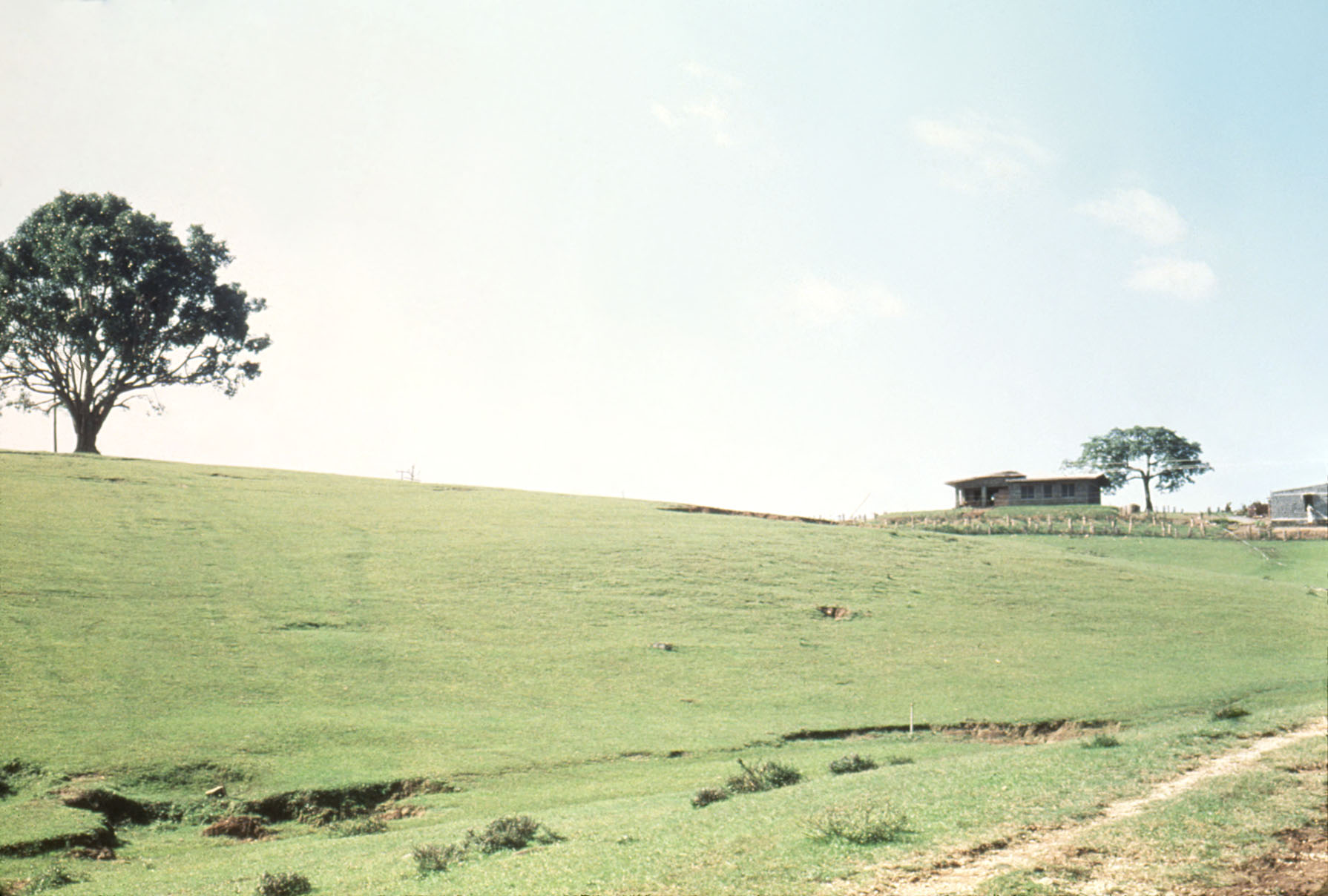
On 8 February 1982, after performing Bhumi Puja to sanctify the 24-acre land of the remote, dry, and poor Ellayapalli village in the Kadapa District of Andhra Pradesh, Gurudev signaled its transformation into a spiritual haven. The Chinmayaranyam Ashram became the site for a Telugu Sandeepany with its first Vedanta Course ably led by Swamini Saradapriyananda, one of the foremost disciples of Gurudev. At Chinmayaranyam, spiritual learning blossomed, fragrant with great seva (service) and uplifting worship.
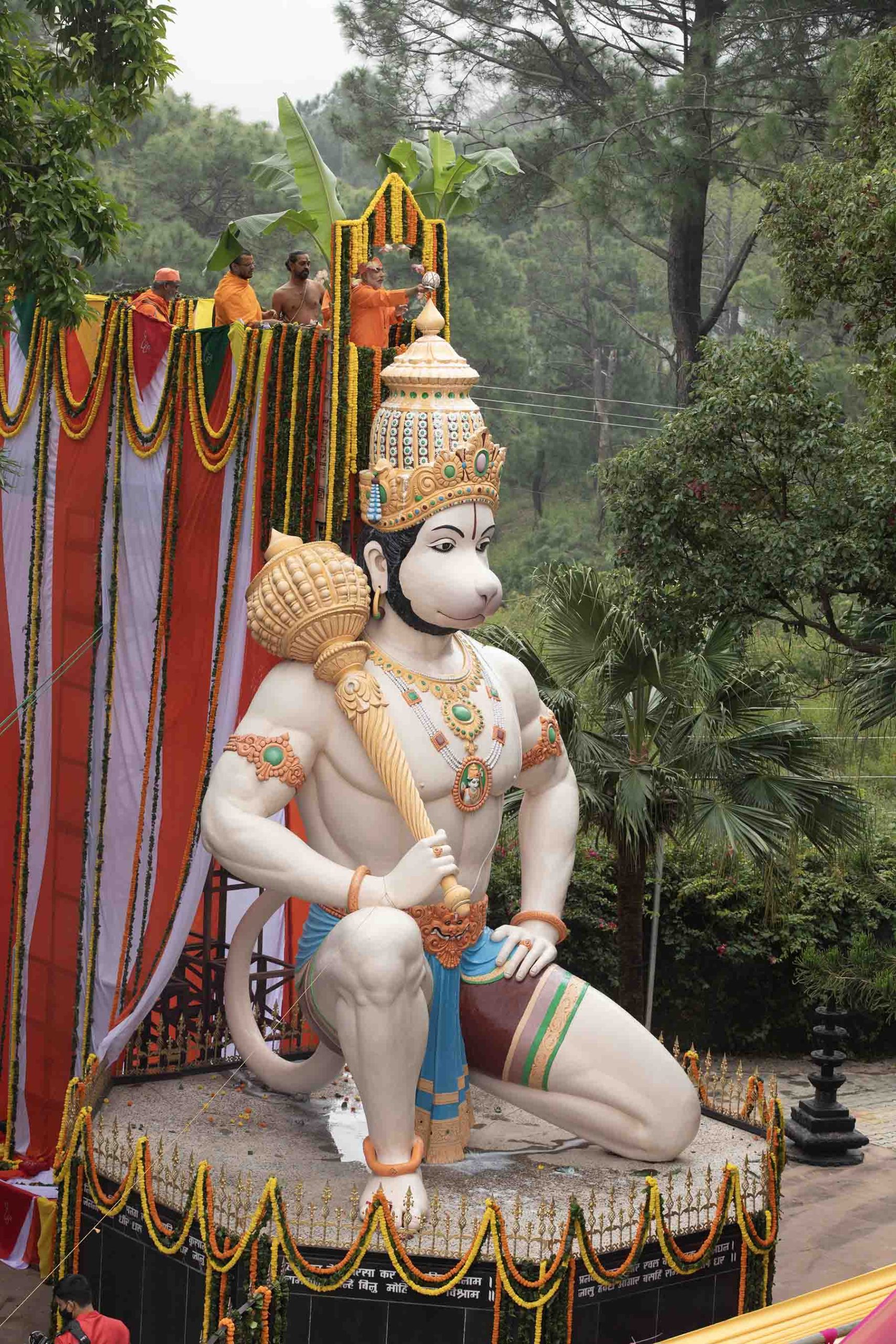
The 22-foot Hanuman idol at the Sidhbari Ashram was consecrated by Gurudev to protect the place from strong winds. Crafted from a simple sketch drawn by Gurudev, Standing on a 6-foot pedestal, the majestic idol was envisioned to bring a sense of divine magic, and sacred wonder to the entire area. The idol was unveiled on 9 October 1982, in the evening following the aarti.
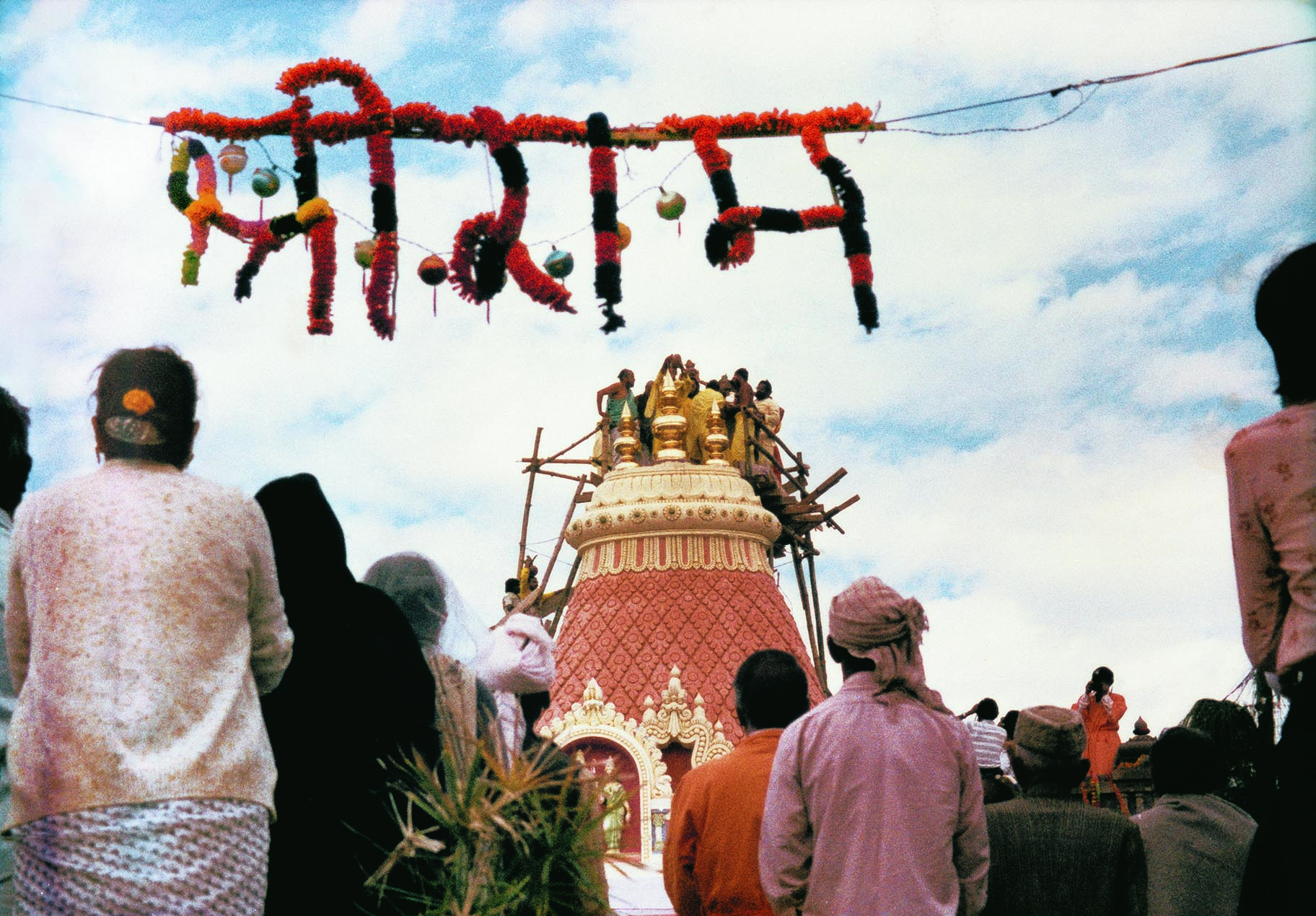
On 21 October 1983, Gurudev offered a rare and precious gift through a special Diksha ceremony, initiating Br. Vivek Chaitanya as Swami Tejomayananda, who would later serve as Pujya Guruji and head the Mission from 1993–2016. On the very next day, Gurudev sanctified the Vanvaasi Shri Ram-Sita Mandir at Sidhbari with a momentous Kumbhabhishekam, blessing generations to come.
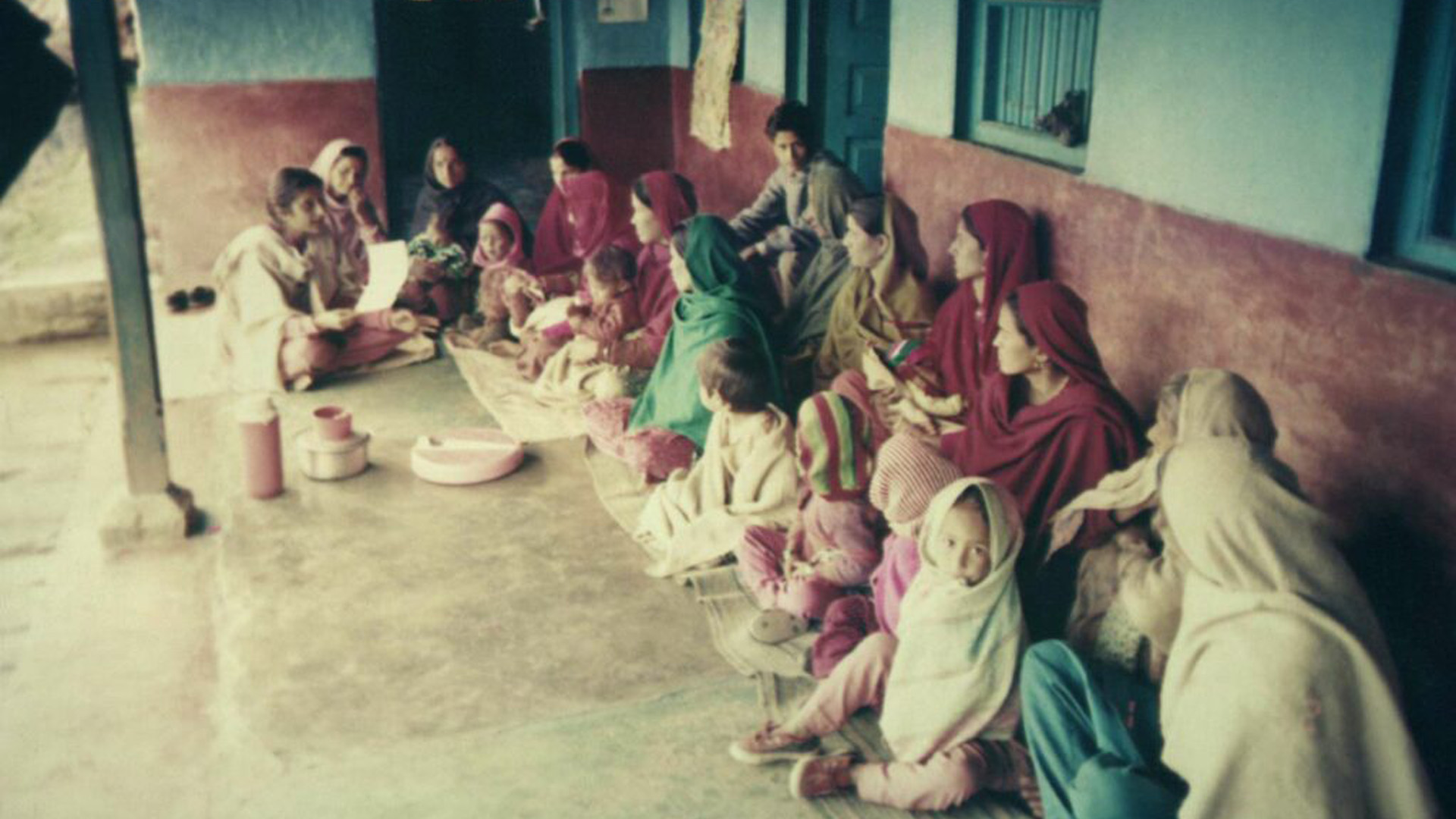
With Vedanta as the guiding principle and selfless seva (service) as the driving motto, the Chinmaya Organization for Rural Development (CORD) took its first steps as the Chinmaya Rural Primary Health Care and Training Centre (CRPHC&TC) on 10 April 1985. Inaugurating it, Gurudev Chinmayananda expressed His purpose behind CORD thus: “The people of the Himalayas, especially women, have selflessly served the wandering sadhus. This will be our repayment of rna (debt) to them. I want to serve them.”
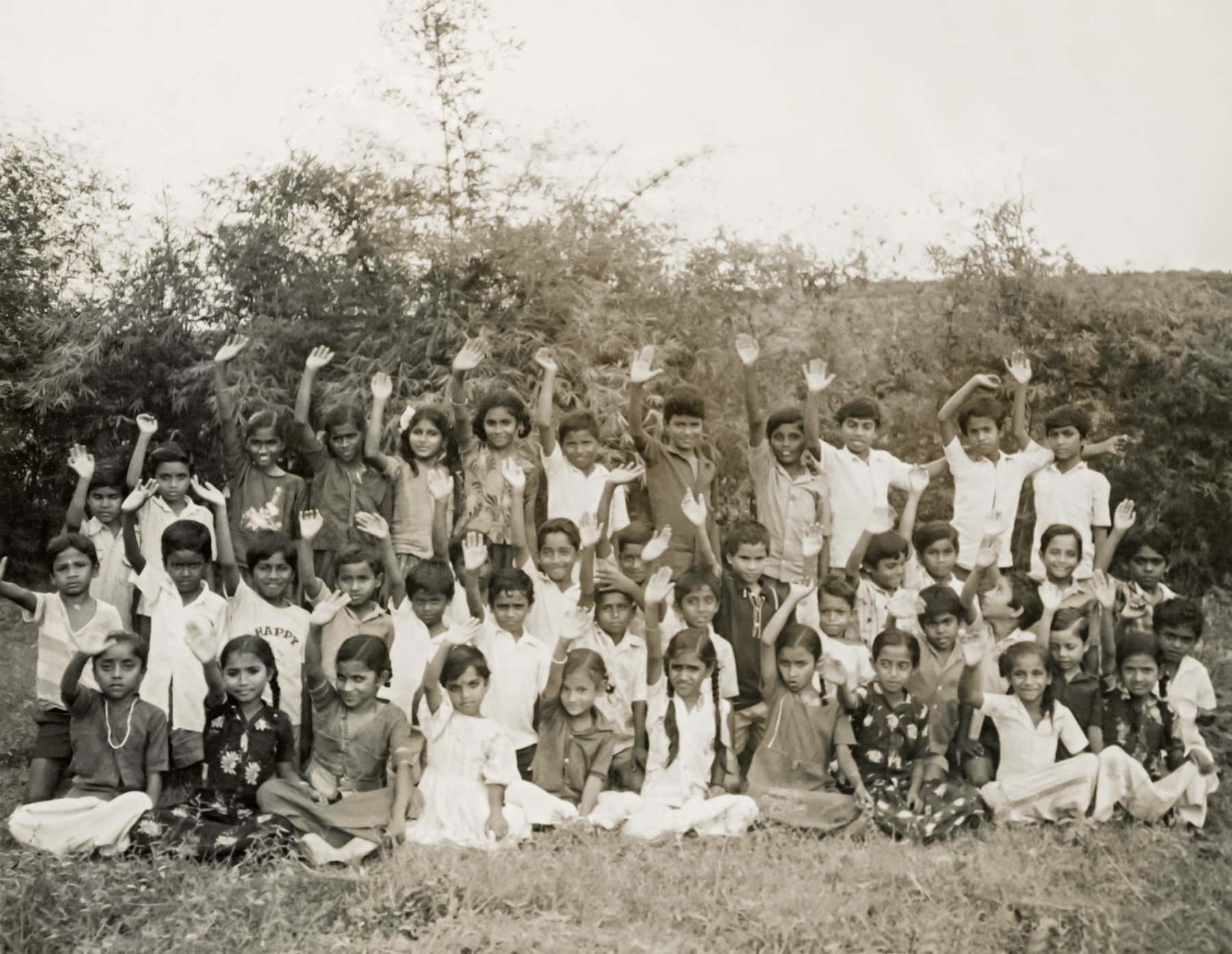
In the remote, backward Mukkavaripalli, Andhra Pradesh on 23 March 1986, Swamini Saradapriyananda inaugurated the first Harihar School. “In order to serve the poorest of the poor in the villages, we have now started, under the Mission, the first of a series of Harihar Schools. The Hari Har Vocational Schools conceive as their major purpose, the obligation to offer the villagers academic and vocational education and to train them for self-employment.” So wrote Gurudev in the April 1986 issue of Tapovan Prasad.
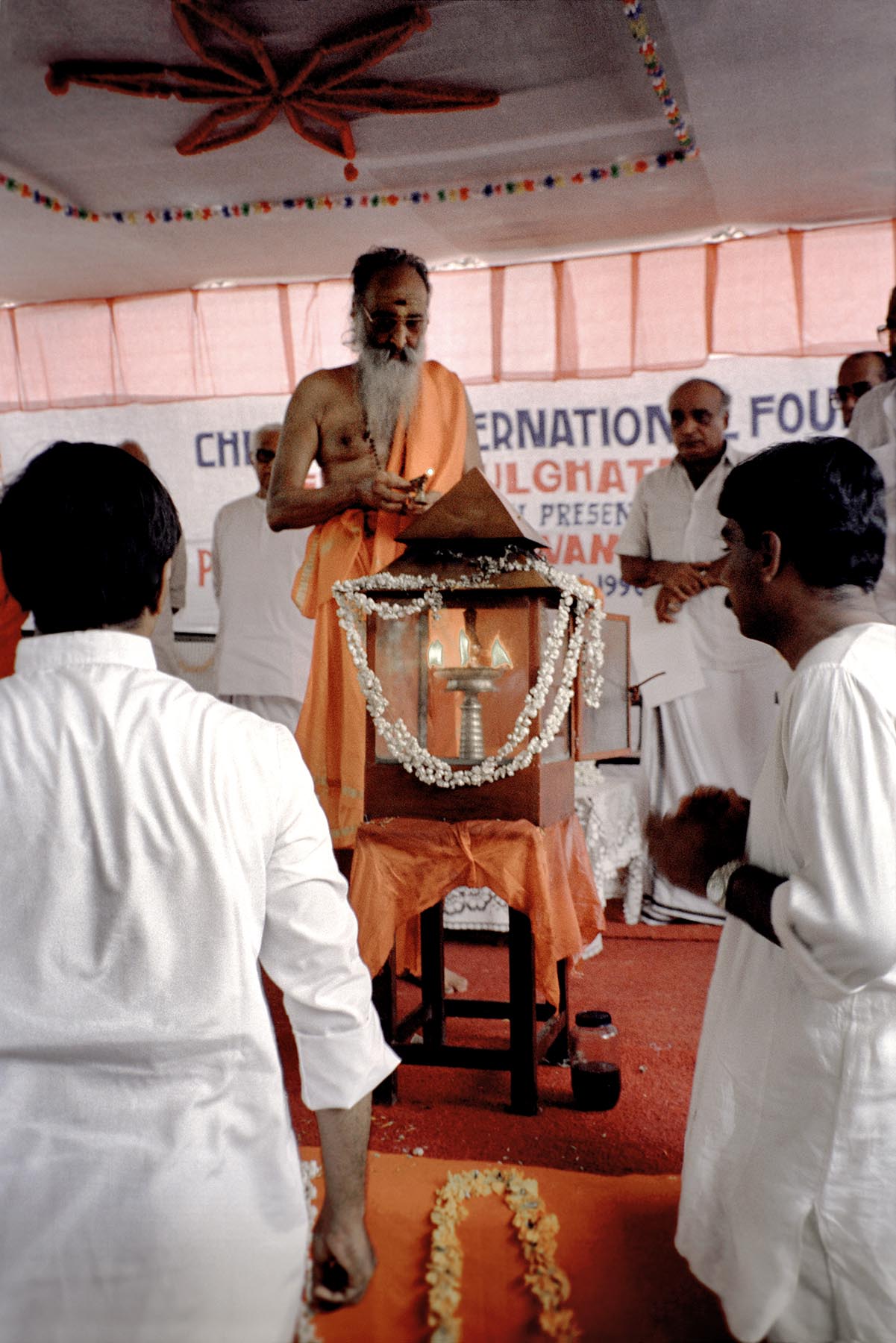
The Chinmaya Internal Foundation (CIF), registered at Cochin (now Kochi) in Kerala on 25 April 1989, was envisioned by Gurudev as a “temple of study and research, a center of Hindu culture, and a life-giving bridge between science and spirituality.” Housed in the sacred maternal home of Shri Adi Sankaracharya, the spiritual stalwart and founder of Advaita philosophy, it started and stands as a world-renowned research wing of Chinmaya Mission dedicated to ancient and modern Indian knowledge traditions.
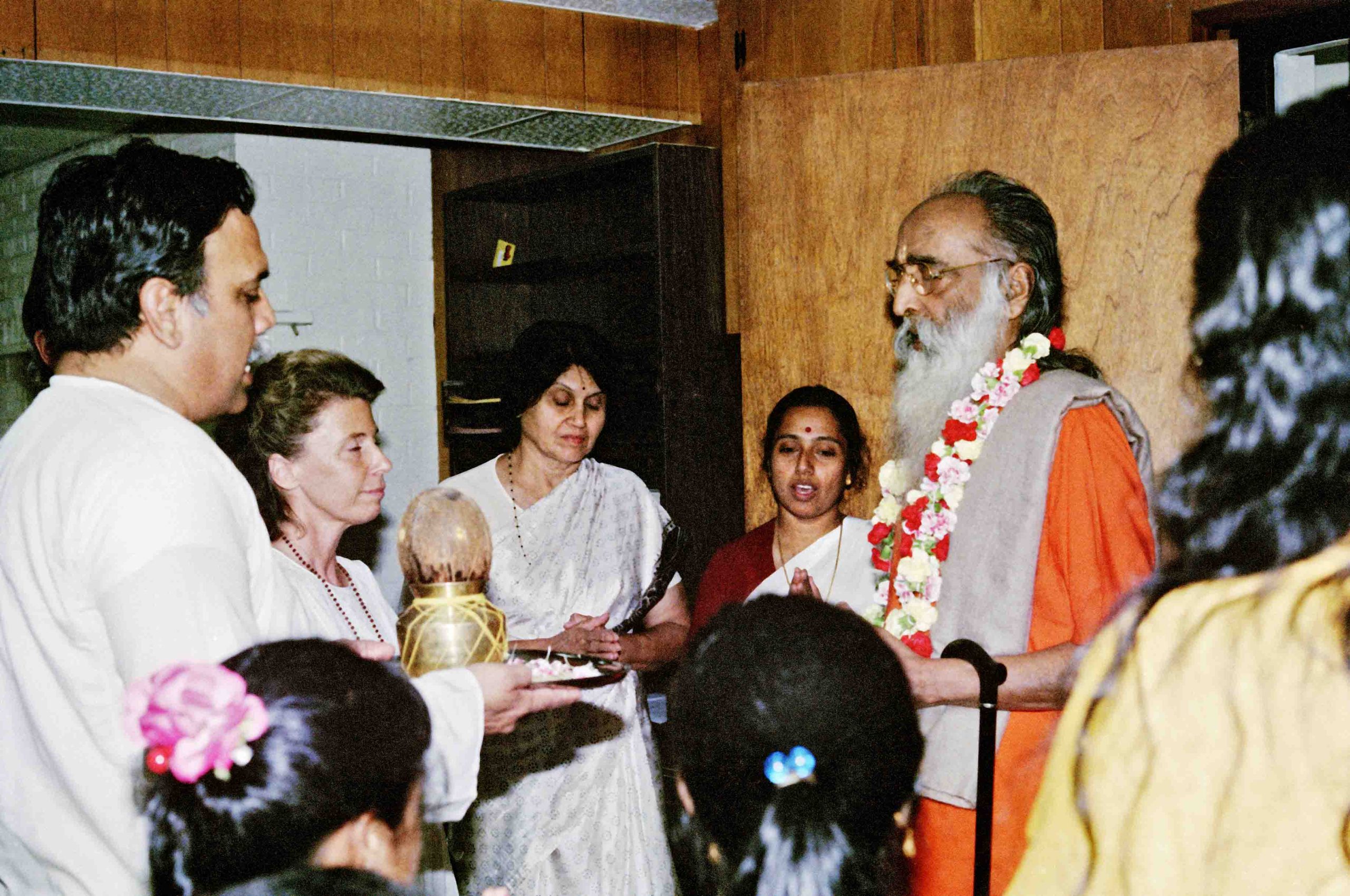
Bhagavad Gita was Gurudev’s life-breath. Coinciding with His 500th Gita Jnana Yajna, the “Chant Gita, Land Washington” competition was launched in India. Children enrolled enthusiastically in the competition that aimed to make the immortal Gita imprinted in young minds. Out of the 10,000 resounding young voices, two winners were selected – Jyothi N. Iyer from Nagpur and R.Sudha from Delhi. They were rewarded with a ten-day trip to visit the Chinmaya Mission centres in the United States.
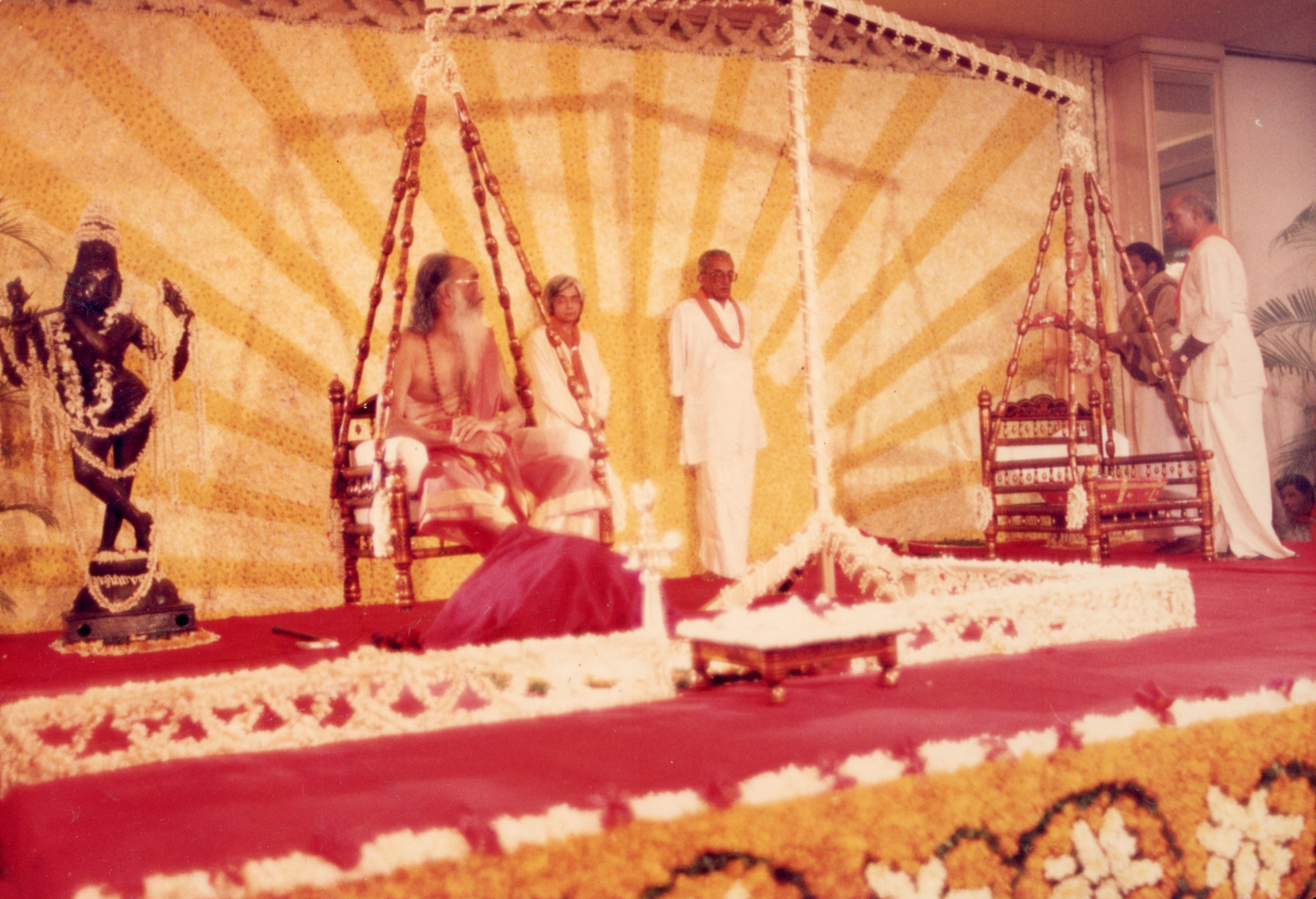
Though no offering can truly match the Guru’s grace and guidance, the Suvarna Tulabharam (a ritual of weighing a person against gold) served as a meaningful gesture of gratitude to mark Gurudev’s 75th birth year. Held on the morning of 24 December 1991 at Hotel Leela Kempinski in Bombay (now Mumbai), the ceremony not only followed an ancient tradition of offering gratitude but also supported the larger, selfless cause of sustaining the Mission.
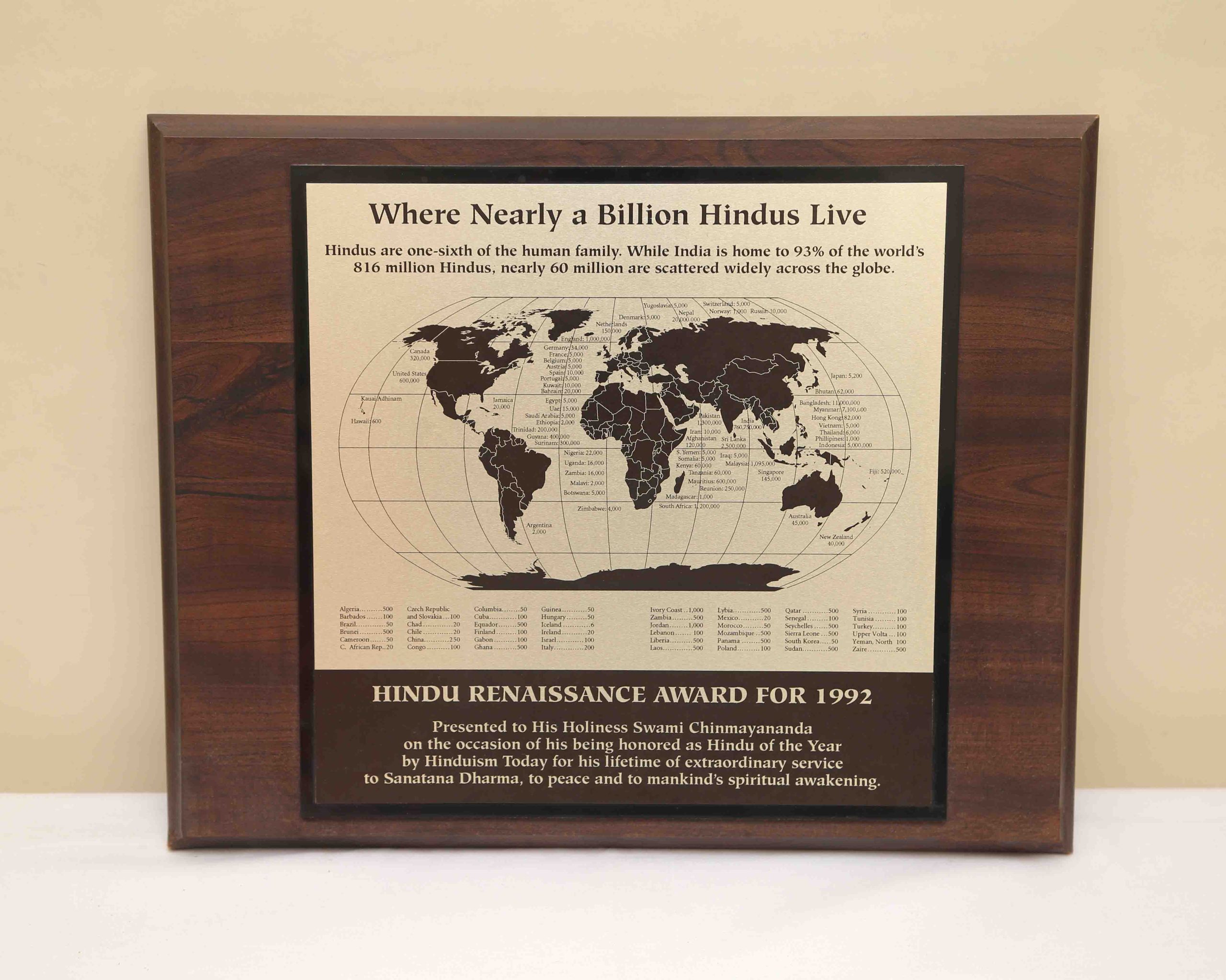
Hinduism Today, a respected quarterly magazine circulated in more than sixty countries, honored Gurudev Swami Chinmayananda with its prestigious 1992 Hindu Renaissance Award. This annual “Hindu of the Year” recognition included a cash prize (₹28,500 at the time) and a commemorative plaque, given to individuals “who make the strongest impact on Hindus worldwide and exemplify Hinduism’s vastness, tolerance, compassion, and spiritual depth.” It was a truly fitting global tribute to Gurudev’s lasting impact on Hinduism.
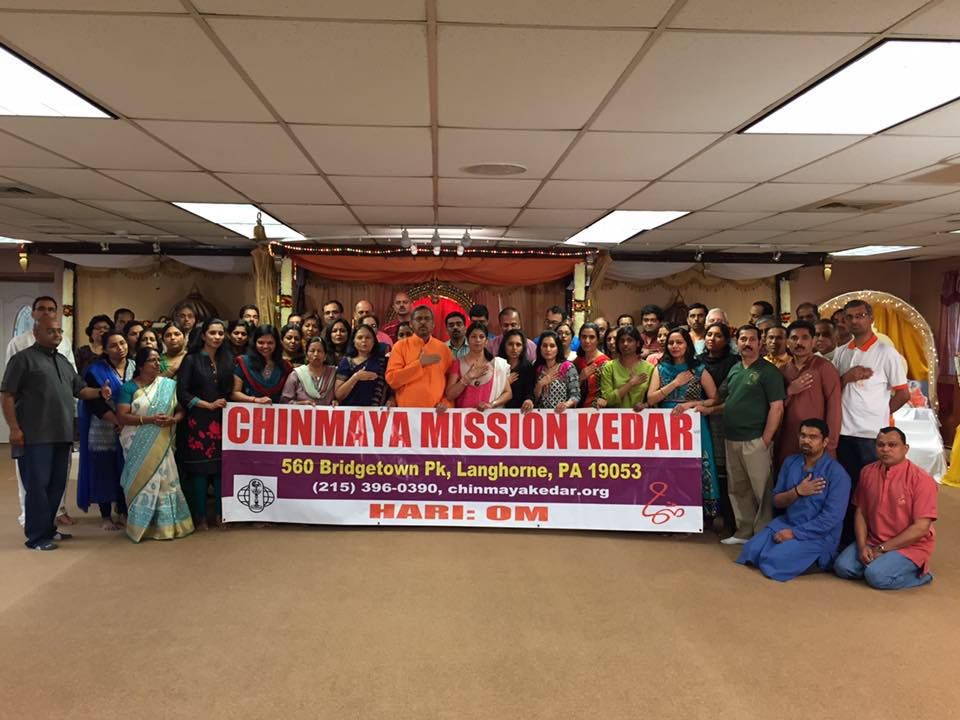
Inaugurated on 30 November 1992, Chinmaya Kedar in Pennsylvania, USA, was the final Chinmaya Mission center to be opened by Gurudev. The presiding deity, Lord Shiva as Kedar, glows afresh with peace and Truth, having emerged from deep meditation. During the inauguration, Gurudev expressed, “This place must become a vibrant center of continuous spiritual activity at all levels.” He outlined how study groups, Bala Vihar classes, Yuvakendra sessions, and Vedantic discourses should enrich the centre.
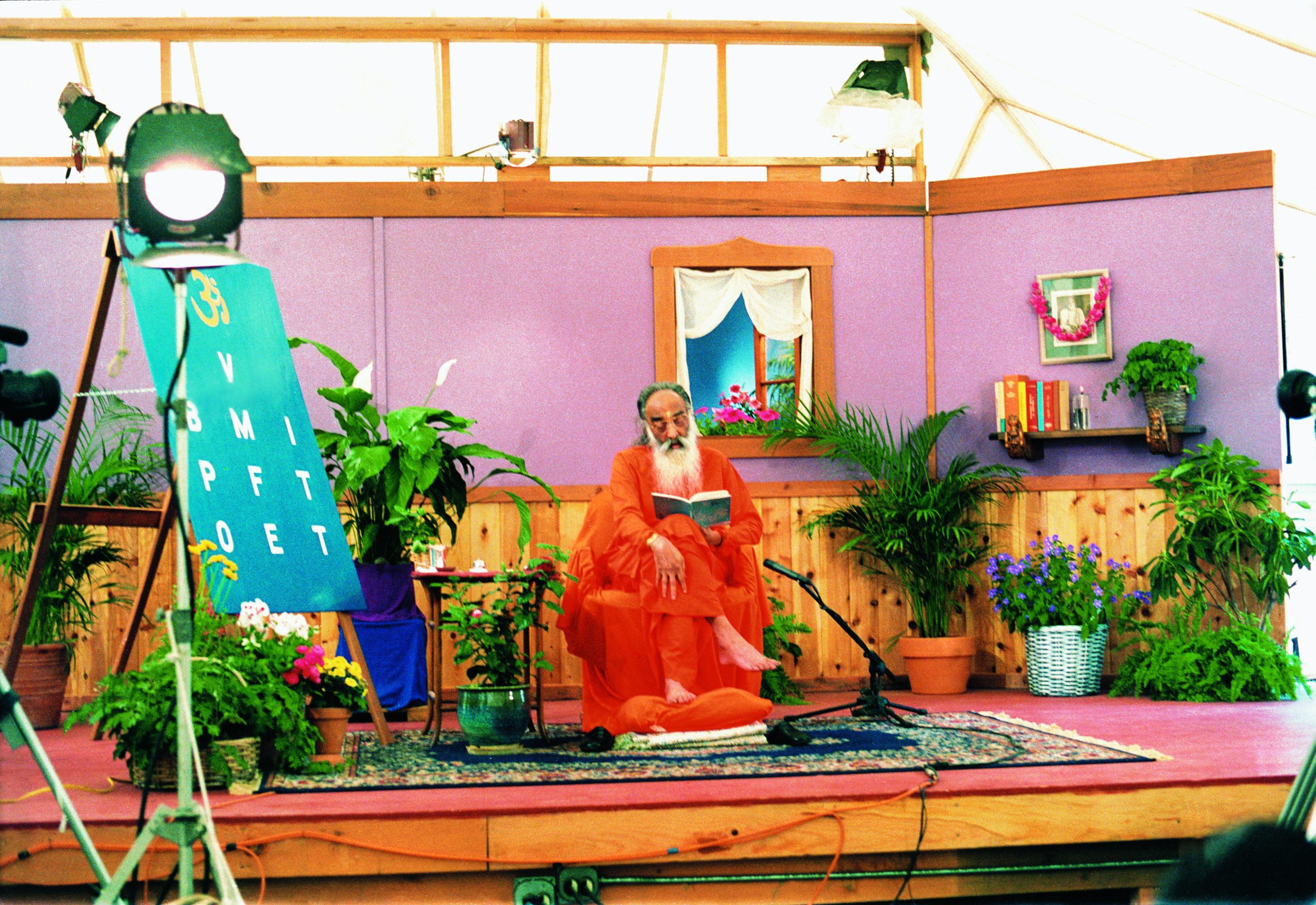
In Massanetta Springs, Virginia (near Washington D.C.) Gurudev taught Gita chapter 17 – The Yoga of Threefold Faith from 19 -25 July 1993. As He thundered with His usual eloquence, little did the camp attendees realize that it was His final Gita Jnana Yajna. In His final discouse, Gurudev explained the verses 25-28. He began that last lecture with: “What happens by evening, we do not know, and you worry about the future?”
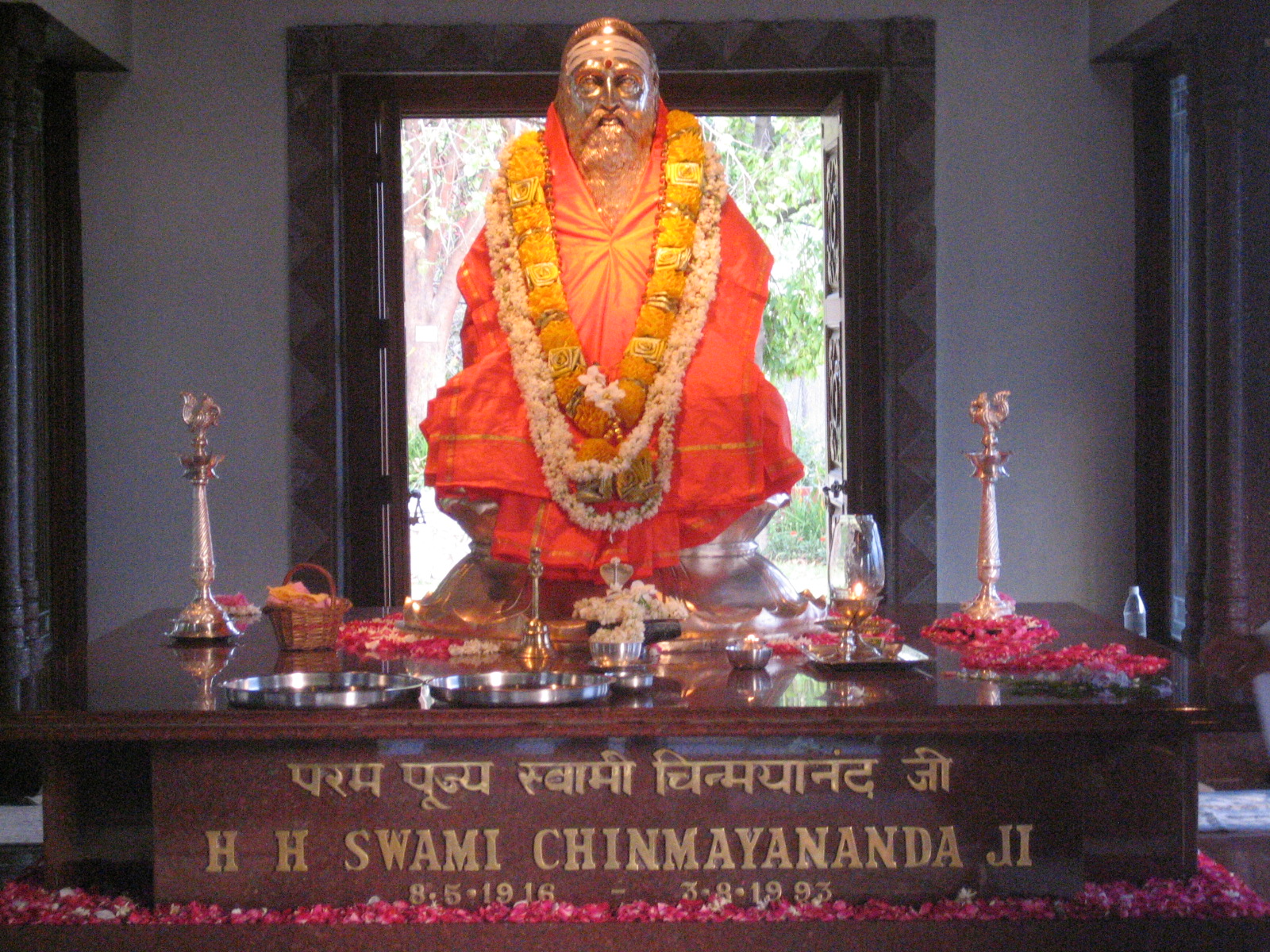
At Sharp Memorial Hospital in San Diego, California, on 3 August 1993, after forty-two years of tireless service as a towering figure of the Hindu Renaissance, Gurudev Swami Chinmayananda (1916–1993) departed from his physical body to shine forever as the Infinite Presence. His body, which had served as a living embodiment of the scriptures, was returned to Mother Bharat on 7 August. Two days later, on 9 August 1993, with profound reverence, it was interred in Bhu Samadhi on the sacred soil of Sidhbari.
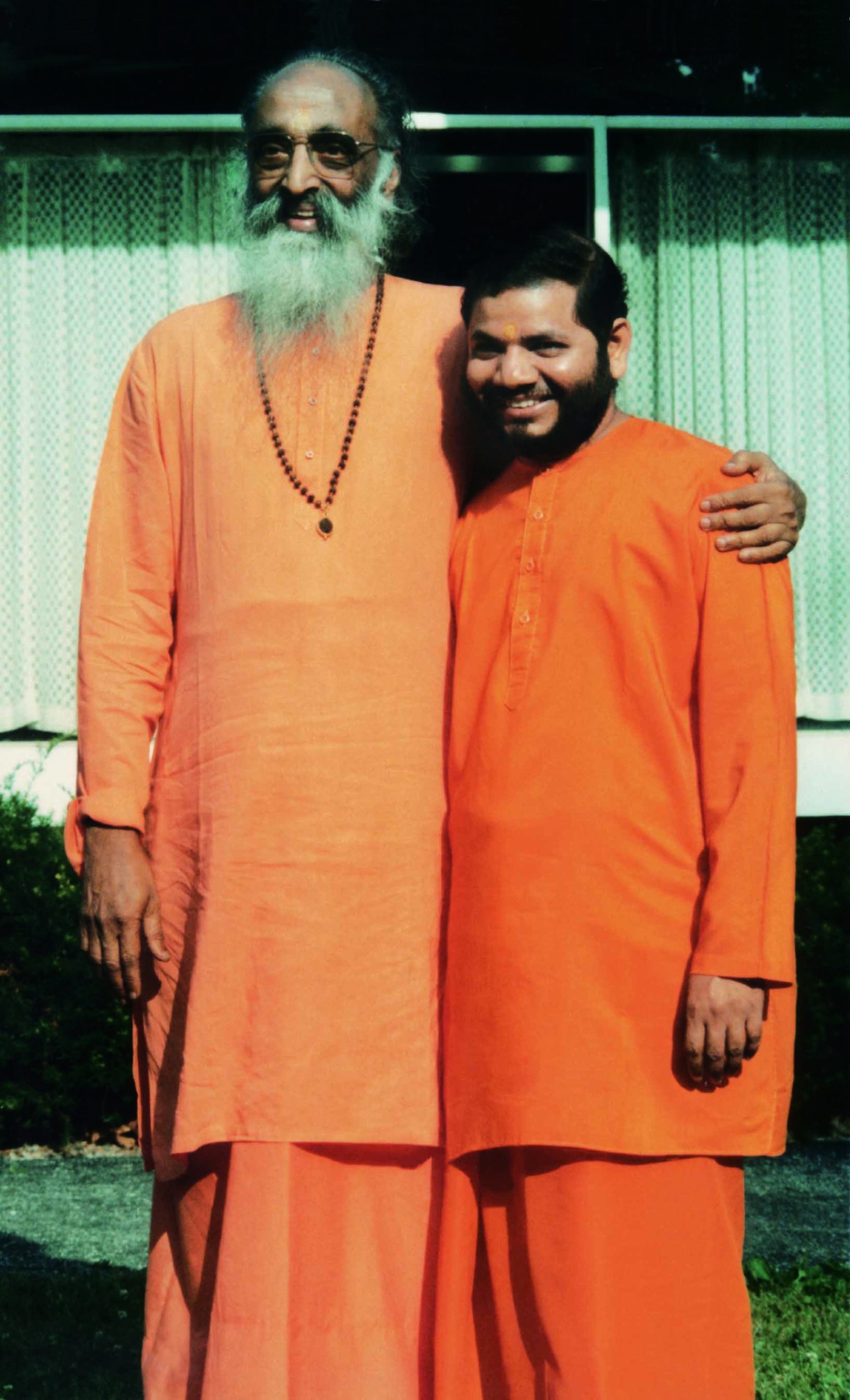
Three weeks after Gurudev’s Mahasamadhi, on 22 August 1993, the CCMT trustees unanimously resolved to appoint His Holiness Swami Tejomayananda as the Chairman of the Central Chinmaya Mission Trust and the Spiritual Head of Chinmaya Mission worldwide, with immediate effect. When someone asked Swami Tejomayananda how it felt to be “in Pujya Gurudev’s shoes,” he replied with great humility: “I am not in His shoes; I am at His Feet.”
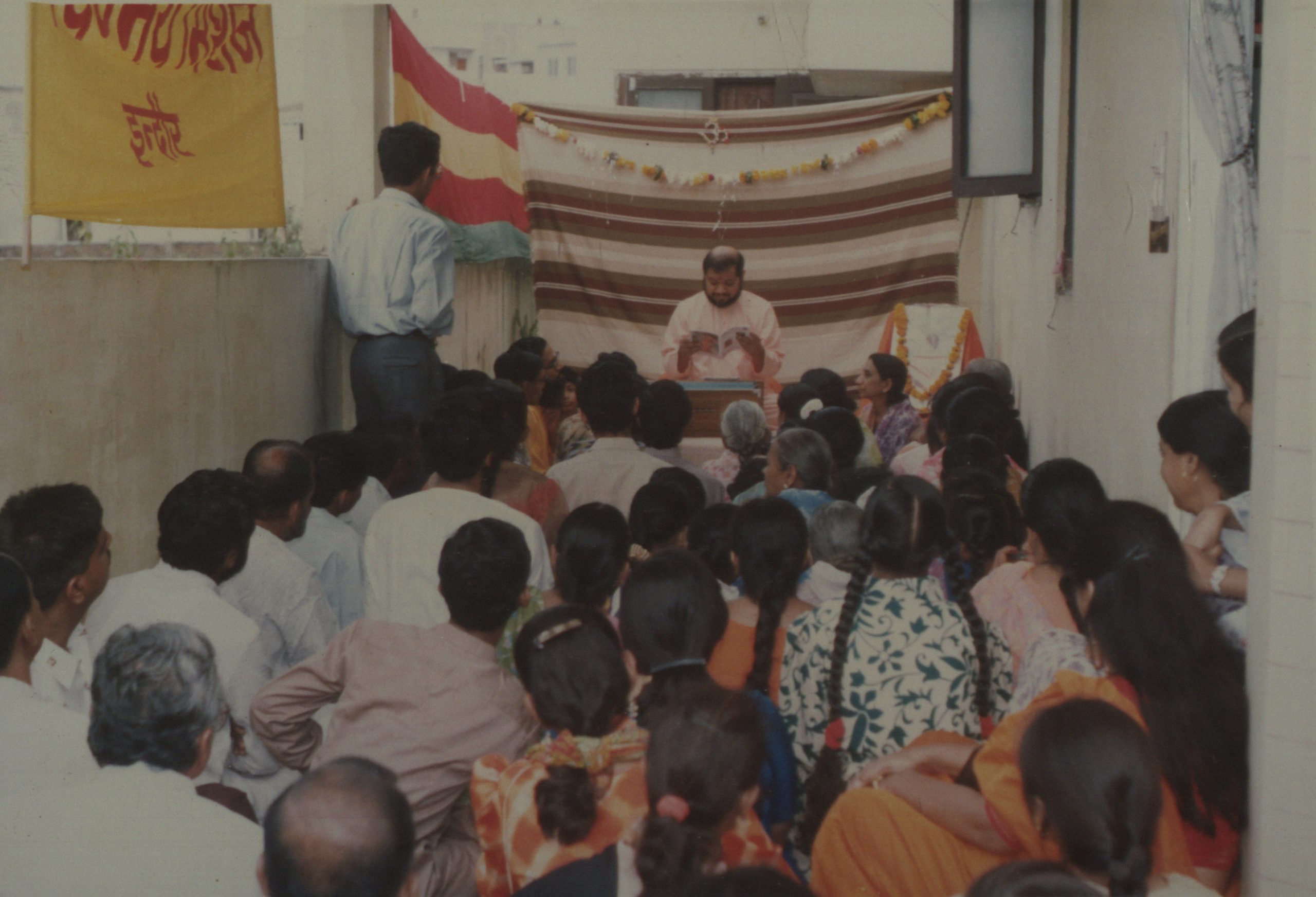
March 1996 brought the first publication of Chinmaya Udghosh (CU) as the international youth magazine of Chinmaya Yuva Kendra (CHYK), the global youth wing of Chinmaya Mission. Br. Abhay Chaitanya (now Swami Abhedananda, CM South Africa) proposed the idea of a youth-focused magazine, which was presented to Guruji Swami Tejomayananda in December 1995. The motto of Chinmaya Udghosh – “Clarion Call for Dynamic Spirituality” – declares its purpose for the youth.
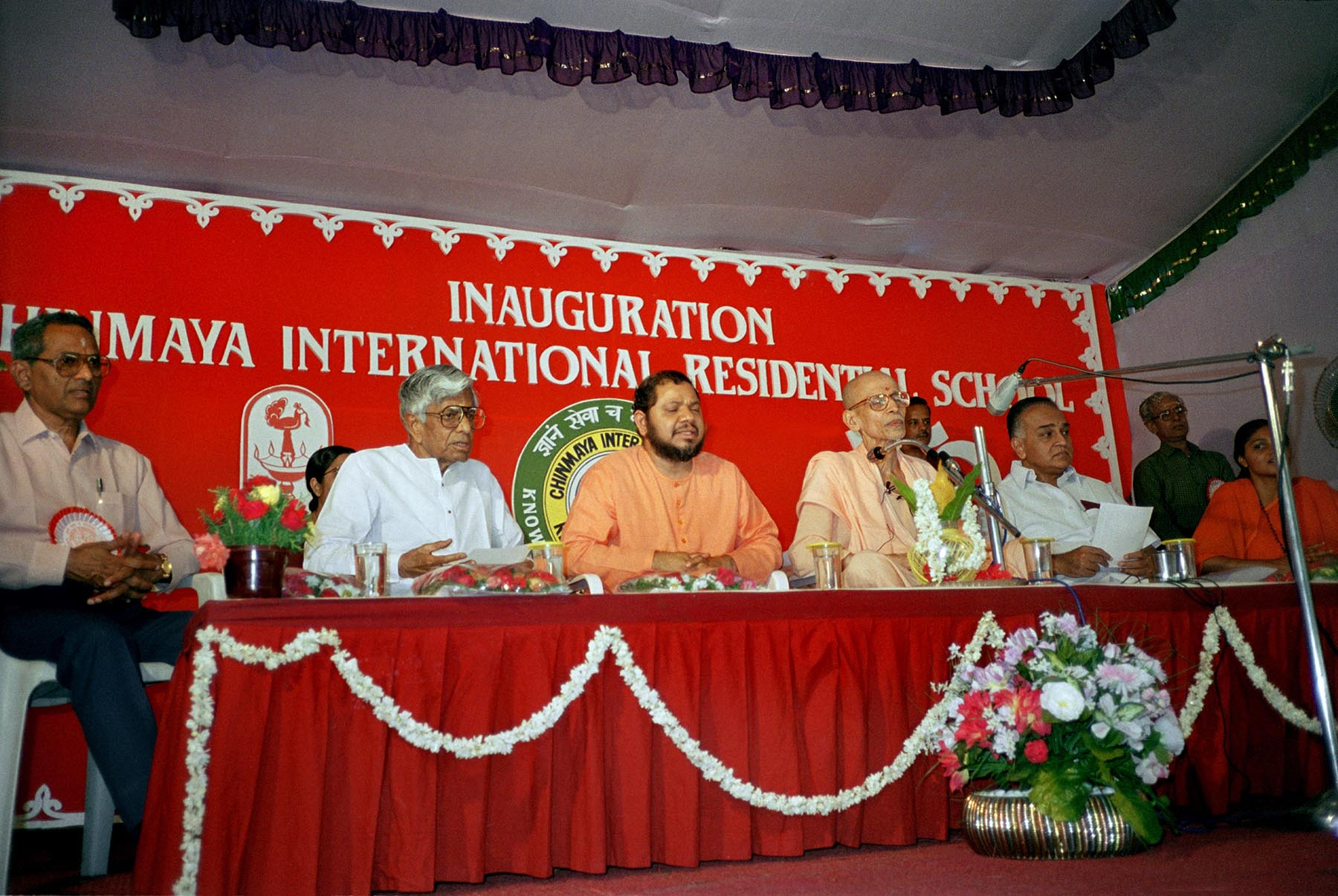
Continuing the focus on value-based education, on 6 June 1996, in the presence of Guruji, Chinmaya International Residential School (CIRS) was inaugurated by the President of the ‘Divine Life Society’, Swami Chidananda.
The school began with 96 students in grades 5–8 and has grown into a premier institution, now hosting 577 students, 69 highly qualified and experienced faculty, and 78 staff members from 23 Indian states and 19 countries (as of 2025).