

Archives Timeline Stories
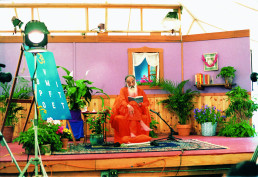
Forever Tuned to Brahman
In Massanetta Springs, Virginia (near Washington D.C.) Gurudev taught Gita chapter 17 - The Yoga of Threefold Faith from 19 -25 July 1993. As He thundered with His usual eloquence, little did the camp attendees realize that it was His final Gita Jnana Yajna. In His final discouse, Gurudev explained the verses 25-28. He began that last lecture with: “What happens by evening, we do not know, and you worry about the future?"

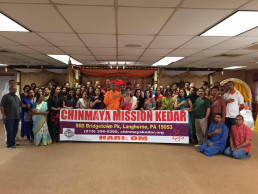
Chinmaya Kedar in Pennsylvania
Inaugurated on 30 November 1992, Chinmaya Kedar in Pennsylvania, USA, was the final Chinmaya Mission center to be opened by Gurudev. The presiding deity, Lord Shiva as Kedar, glows afresh with peace and Truth, having emerged from deep meditation. During the inauguration, Gurudev expressed, “This place must become a vibrant center of continuous spiritual activity at all levels.” He outlined how study groups, Bala Vihar classes, Yuvakendra sessions, and Vedantic discourses should enrich the centre.
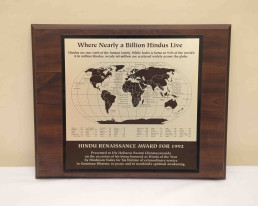
A Tireless Hero of Sanatana Dharma
Hinduism Today, a respected quarterly magazine circulated in more than sixty countries, honored Gurudev Swami Chinmayananda with its prestigious 1992 Hindu Renaissance Award. This annual “Hindu of the Year” recognition included a cash prize (₹28,500 at the time) and a commemorative plaque, given to individuals “who make the strongest impact on Hindus worldwide and exemplify Hinduism’s vastness, tolerance, compassion, and spiritual depth.” It was a truly fitting global tribute to Gurudev’s lasting impact on Hinduism.
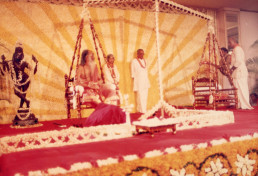
75th Birthday with Golden Gratitude
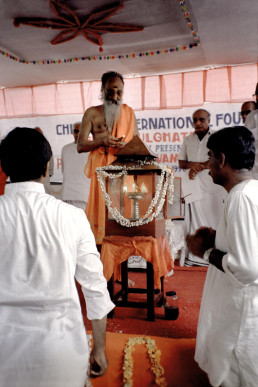
Though no offering can truly match the Guru’s grace and guidance, the Suvarna Tulabharam (a ritual of weighing a person against gold) served as a meaningful gesture of gratitude to mark Gurudev’s 75th birth year. Held on the morning of 24 December 1991 at Hotel Leela Kempinski in Bombay (now Mumbai), the ceremony not only followed an ancient tradition of offering gratitude but also supported the larger, selfless cause of sustaining the Mission.
Nationwide Gita Chanting
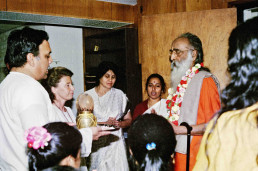
Bhagavad Gita was Gurudev’s life-breath. Coinciding with His 500th Gita Jnana Yajna, the “Chant Gita, Land Washington” competition was launched in India. Children enrolled enthusiastically in the competition that aimed to make the immortal Gita imprinted in young minds. Out of the 10,000 resounding young voices, two winners were selected - Jyothi N. Iyer from Nagpur and R.Sudha from Delhi. They were rewarded with a ten-day trip to visit the Chinmaya Mission centres in the United States.
A Scriptural Research Bridge - CIF
The Chinmaya Internal Foundation (CIF), registered at Cochin (now Kochi) in Kerala on 25 April 1989, was envisioned by Gurudev as a “temple of study and research, a center of Hindu culture, and a life-giving bridge between science and spirituality.” Housed in the sacred maternal home of Shri Adi Sankaracharya, the spiritual stalwart and founder of Advaita philosophy, it started and stands as a world-renowned research wing of Chinmaya Mission dedicated to ancient and modern Indian knowledge traditions.
Serving to Educate: Harihar Schools
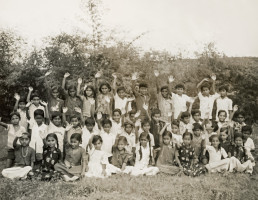
In the remote, backward Mukkavaripalli, Andhra Pradesh on 23 March 1986, Swamini Saradapriyananda inaugurated the first Harihar School. “In order to serve the poorest of the poor in the villages, we have now started, under the Mission, the first of a series of Harihar Schools. The Hari Har Vocational Schools conceive as their major purpose, the obligation to offer the villagers academic and vocational education and to train them for self-employment.” So wrote Gurudev in the April 1986 issue of Tapovan Prasad.
Rural Upliftment, Chinmaya Style
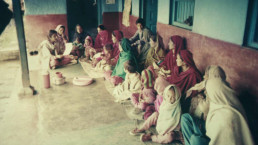
With Vedanta as the guiding principle and selfless seva (service) as the driving motto, the Chinmaya Organization for Rural Development (CORD) took its first steps as the Chinmaya Rural Primary Health Care and Training Centre (CRPHC&TC) on 10 April 1985. Inaugurating it, Gurudev Chinmayananda expressed His purpose behind CORD thus: “The people of the Himalayas, especially women, have selflessly served the wandering sadhus. This will be our repayment of rna (debt) to them. I want to serve them.”
Paving the Way for a New Era
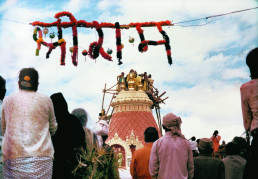
On 21 October 1983, Gurudev offered a rare and precious gift through a special Diksha ceremony, initiating Br. Vivek Chaitanya as Swami Tejomayananda, who would later serve as Pujya Guruji and head the Mission from 1993–2016. On the very next day, Gurudev sanctified the Vanvaasi Shri Ram-Sita Mandir at Sidhbari with a momentous Kumbhabhishekam, blessing generations to come.
Sidhbari’s Vayuputra Hanuman
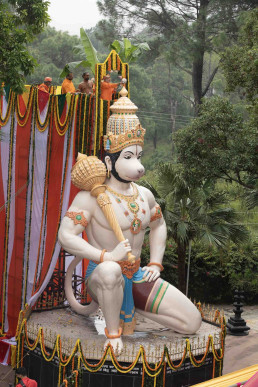
The 22-foot Hanuman idol at the Sidhbari Ashram was consecrated by Gurudev to protect the place from strong winds. Crafted from a simple sketch drawn by Gurudev, Standing on a 6-foot pedestal, the majestic idol was envisioned to bring a sense of divine magic, and sacred wonder to the entire area. The idol was unveiled on 9 October 1982, in the evening following the aarti.