

Archives Timeline Stories
Chinmaya Publication Trust
With His far-reaching vision, Gurudev launched the Chinmaya Publication Trust on 8 March 1961 in Madras, handing about 59 books authored by him for future publications. Over the years, the Trust became the precursor for the prolific Chinmaya Publications numbering over 900 titles currently. What started with books, now has additional categories such as pen drives, audio CDs, video DVDs, monthly magazines under the Chinmaya Mission (CM) banner, and CM-themed gifts.

The First Residential Academy
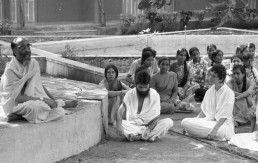
Gurudev envisioned Sandeepany Sadhanalaya, a Gurukula (residential academy) where the future torchbearers of Vedanta would be trained. Since 1957, he searched tirelessly for the perfect space to build an abode that would kindle the flame of perfection, as its very name suggests. Inspired by one of his powerful talks, a devoted seeker, Smt. Tara Sarup, offered her land in Powai, Mumbai, for this noble cause. Soon, the space for the first Sandeepany Sadhanalaya was registered on 19 January 1960.
Study Groups for Women
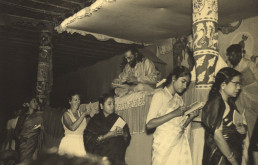
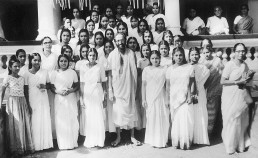
The spiritual inclination among women was strong, and Gurudev’s yajnas ignited a deep yearning to understand Vedanta more profoundly. It was time for the women of the expanding Chinmaya Family to build their own forum to gather and grow. Thus, on the Sunday of 2 November 1958, at Chinmaya Nilayam, 16 Harrington Road, Madras (now Chennai), the first Devi Group was inaugurated.
Launch of the Monthly Magazine - Usha
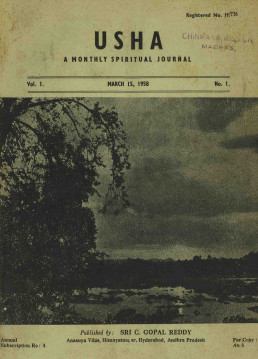
Named after the Hindu goddess of dawn, indicating a new beginning and revival, Usha, the monthly magazine of Chinmaya Mission had its first issue released on 15 March 1958. In the editorial Gurudev wrote, “It is time that the Groups must come together and their activities get somehow co-ordinated and systematized, each group drawing its inspiration from its sister-groups functioning elsewhere in India. USHA will be this messenger; she will contact all Groups by her awakening rays!"
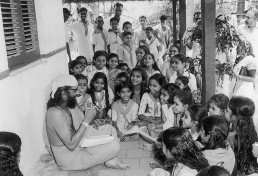
Beginning of Bala Vihar
The clarion call that Gurudev made during the Hindu Renaissance drew not just the adults. Everywhere He went, the very young too felt that magnetic pull in His booming laughter, His cheerful spirit, and His extraordinary love. Naturally, in His Jnana Yajnas, a place was made to nourish the children, the future of Chinmaya Mission. With great love and care, the beautiful garden of Bala Vihar took shape first as the tender “Children’s Welfare” sections in different Chinmaya Mission centres during the late 1950s.
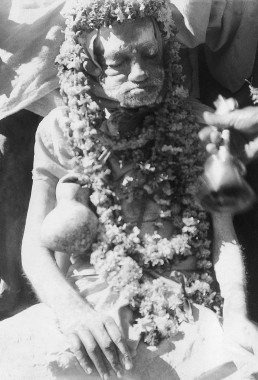
Swami Tapovan Maharaj’s Mahasamadhi
“Death is born with us when we are born,” consoled a deeply ailing Swami Tapovan Maharaj when Gurudev was heartbroken during the last meeting with His peerless Guru in the first week of December 1956. Then, at the serene and auspicious time of 4:30 AM on the full moon day of 16 January 1957, Swami Tapovan Maharaj attained Mahasamadhi. In His most reverential tribute, Gurudev expressed, “A God without temple, A Veda without language, was this master mind and he lived for 68 years; a monumental expression of an ideal Vedantic Teacher.”
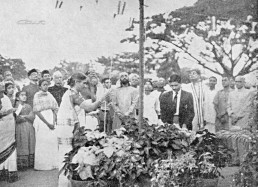
25th Jnana Yajna
From December 1951 in Pune to December 1956 in Hyderabad, Gurudev’s tireless efforts through Jnana Yajnas ignited a wave of renewed interest in the Vedic scriptures. To commemorate the sterling milestone at the 25th Jnana Yajna, the first volume of a publication called “Hail Renaissance” was brought out. Crowning the publication was a letter from Gurudev dated 20 December 1956 heralding the budding Hindu Renaissance. It also included His article about the genesis of the Chinmaya movement along with testimonials from devotees.
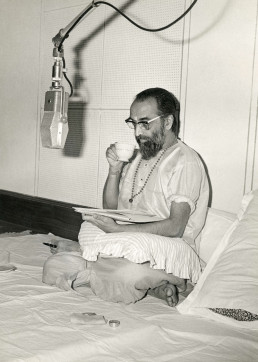
All India Radio Talks
During the 13th Jnana Yajna in New Delhi, Gurudev was invited by All India Radio, the national public broadcaster, for a three-part broadcast on key topics in spirituality. With His commanding voice, He reminded Indians again about their spiritual status: "Ours is an Age of Science. The new India, thrilled with her freedom, is looking forward to a healthy future wherein the maximum number can come to enjoy the maximum amount of peace and happiness in life. From time immemorial, ours has been the land of spiritualism, and the whole world has been looking up to us to teach them the right way of living…”
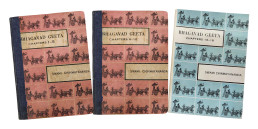
Jnana Yajna 13 - Discourses on the Bhagavad Gita
“The Gita is therefore to be studied and delivered to as many devotees as possible. This Pravachana - missionary zeal in propagation - has been emphasized in our scriptures also. The Lord’s Divine Song was not a prescription for one Arjuna of the Mahabharata days. It is for all times to all of us - Arjuna is a sample young man of the world,” stated Gurudev during His first Gita Jnana Yajna (18 Sep - 26 Oct 1955) at the Modern School, Barakhambha Road, New Delhi, after He explained the meaning of the Gita Dhyanam and highlighted the lasting relevance of Srimad Bhagavad Gita.
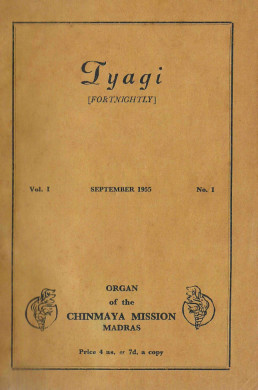
Launch of the Fortnightly Magazine - Tyagi
By the September of 1955, there were already more than 35,000 ardent devotees who had reached out to Gurudev requesting for the Yagna Prasad booklets to be mailed to their addresses. Recognising the great demand for the booklets and the fact that it was becoming inefficient timewise and financially to do the bulk mailing, an enthusiastic group seeked Gurudev’s approval for the launch of a fortnightly magazine. “Tyagi” was born on 1 September 1955, with Gurudev's exhortation, “May Tyagi hold the torch high…” A treasured blessing followed from Swami Tapovan Maharaj as He received the first issue.