

Archives Timeline Stories
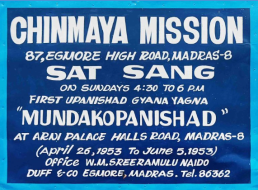
The Mission gains Momentum
The pace picked up significantly after the second Yajna in Chennai gave birth to Chinmaya Mission. While the organisation formulated its structure and code of conduct, Gurudev took the message of the major Upanishads to the prominent cities of India to awaken and elevate the educated. From Mundakopanishad in Madras (now Chennai), He elevated the intensity in Mandukya Upanishad in Delhi and drenched the rest of the cities with His Vedantic eloquence during His first eleven Upanishad Jnana Yajnas.

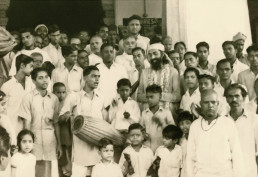
Foundation of Chinmaya Mission
“Don’t start any organisation in my name. I have not come here to be institutionalised. I have come here to give the message of our ancient sages, which has benefited me. If it has benefited you also, pass it on.” This was the reply that a group of earnest devotees received when they wrote to Gurudev in Uttarkashi after the second yajna in Chennai that ended in June 1953. What they wanted was an umbrella organisation to unite the growing forums of deeper study and reflection. So, they persisted: Since the word ‘Chinmaya’ stood for ‘true knowledge,’ and they were seekers of that Truth, it was apt to call the organisation, “Chinmaya Mission.” When Gurudev accepted that request with His compassion, Chinmaya Mission was born and registered on 8 August 1953.
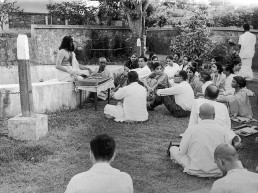
Chinmaya Study Groups
Gurudev’s thunderous pravachans (discourses) left seekers thirsting for more. Many sincere seekers who were captivated by His compelling wisdom wanted to bask in His teachings. This desire to reflect, relearn, and reinforce through joint discussions spawned the Chinmaya Study Groups that sprung up in every city beginning with the second Jnana Yajna in Chennai. Though Gurudev had encouraged seekers to strengthen their understanding through small group study sessions during the very first Jnana Yajna, the first structured Study Group truly took shape after the second Jnana Yajna. This initiative eventually gave rise to the formation of Chinmaya Mission as the guiding and coordinating organisation.
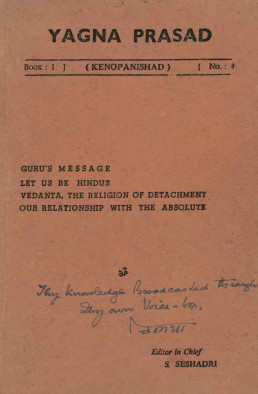
Yagna Prasad - Discourses in Print
The fire of spiritual thirst had been kindled by that incomparable 100-day Upanishad Jnana Yajna, and Gurudev was astute about keeping the flames growing. He ensured that every discourse starting from His introductory talks on Hinduism in several public venues before the first yajna were carefully recorded on paper. Gurudev personally reviewed the shorthand notes, and the edited discourses were printed within 24 hours as booklets titled "Yagna Prasad.” With great humility, Gurudev sent the first copy of the Yagna Prasad to his Guru, Swami Tapovan Maharaj, in Uttarkashi, with the message, "Thy Knowledge Broadcasted through Thy own Voice-box.”
The First Jnana Yajna
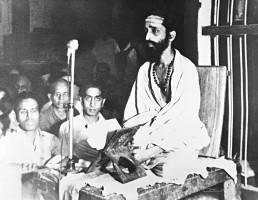
With four annas (currency unit formerly used in British India) in his pocket, Swami Chinmayananda alighted at the railway station of Pune (then known as Poona) on 23 December 1951 and began his first discourse that very evening. In those days, yajna meant the long traditional havans, the elaborate fire rituals. Taking cue from the Bhagavad Gita, he brought alive the jnana yajna (a series of Spiritual Discourses), where the fire of spiritual knowledge is kindled and the primal ignorance is burnt forever. The 100-day Upanishad Jnana Yajna that followed was a saga par excellence.
The Gangotri Plan - Knowledge from the peaks to the plains
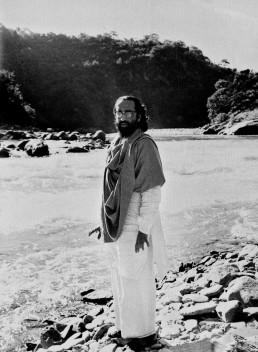
An afternoon midsummer dream, born on the banks of the roaring Ganga at Gangotri, grew into an irresistible calling. The rushing waters of the mighty river sparked in the young Swami Chinmayananda, a divine vision to bring the ancient wisdom of Vedanta from the Himalayas down to the common people. Gaining permission from his Guru, Swami Tapovan Maharaj, He set out on an All-India Tour from May to October of 1951. When He returned to Uttarkashi, Swami Chinmayananda carefully envisioned the Gangotri Plan, initiating a spiritual revolution through self-unfoldment and selfless service.